
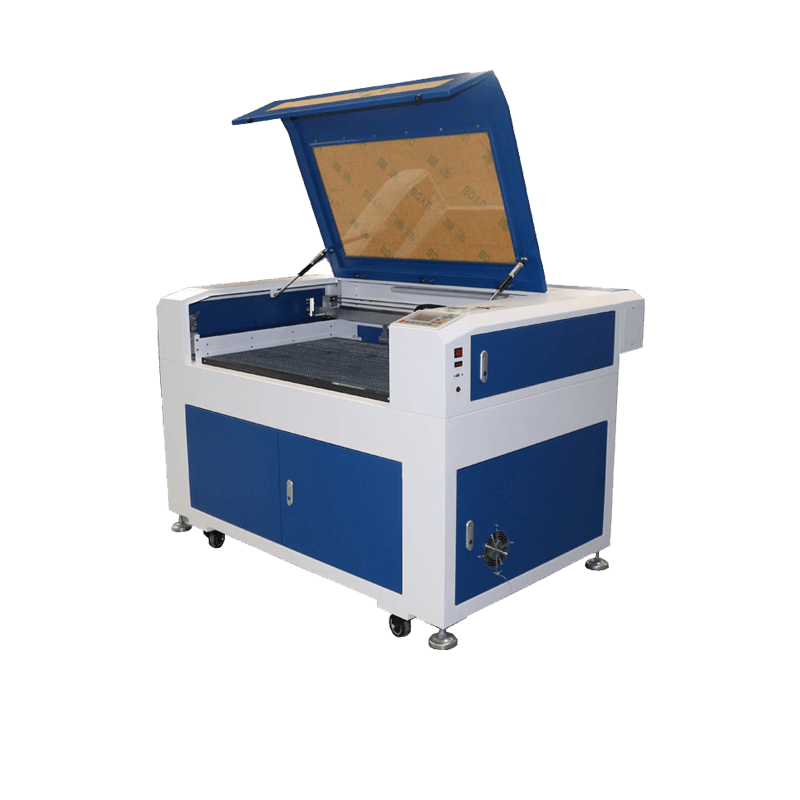
The CO2 laser gets its name from the gas mixture inside the resonator tube: carbon dioxide, nitrogen, and helium. When electrical current passes through this gas mixture, it excites the CO2 molecules, which then emit photons of infrared light at a wavelength of 10.6 micrometers. That wavelength is what makes CO2 lasers uniquely suited to organic materials. Unlike fiber lasers, whose shorter wavelength is absorbed efficiently by metals, the 10.6-micron beam of a CO2 laser is absorbed readily by wood, acrylic, paper, leather, and glass.
The beam is directed through a series of mirrors to a cutting head, where a lens focuses it onto the material. The focused beam vaporizes or melts the material along the programmed path. A coaxial nozzle blows compressed air or an inert assist gas to clear debris and cool the cut edge. The motion system moves either the cutting head or the material bed depending on the machine configuration.
CO2 laser cutting machines come in several form factors. Flatbed machines handle sheets of material and are common in signage, packaging, and furniture production. Galvo-head machines use fast-moving mirrors to steer the beam, enabling very high speeds for thin materials and marking applications. Flying optic machines move the cutting head over a stationary bed, while hybrid configurations move both the head and the material for greater flexibility.
What CO2 Lasers Cut Best
CO2 laser cutting machines are unmatched for non-metallic materials, and understanding which materials work well is essential to choosing the right manufacturer and machine configuration.
Acrylic is one of the most common materials processed, cut cleanly and polished in a single pass. The edges come out flame-polished, requiring no secondary finishing. Wood and plywood are cut easily, though the type of wood and its resin content affect cut quality. MDF and particleboard cut cleanly but produce more smoke and require good extraction. Leather and textiles, including cotton, polyester, and felt, are cut with sealed edges that resist fraying, which is why CO2 lasers are standard in fashion and upholstery production. Paper and cardboard are cut at very high speeds and are common in packaging and prototyping. Glass is not cut in the traditional sense but is scribed and then broken along the score line.
Some materials should never be cut with a CO2 laser. PVC releases chlorine gas and hydrochloric acid, which corrode the machine and pose health risks. Polycarbonate and ABS melt rather than vaporize cleanly. Polyurethane foams can ignite. Knowing these limitations is part of working safely with the technology.
Power Ratings and Their Practical Meaning
CO2 laser cutting machine manufacturers offer systems across a wide power range, typically from around 40 watts to 400 watts for flatbed machines, with larger industrial systems reaching higher. The power rating determines the thickness of material that can be cut and the speed at which cutting can be performed.
Low-power machines, in the 40 to 60 watt range, are suited to thin materials and fine detail work. They are common in small shops, schools, and maker spaces where the primary work is engraving and cutting thin acrylic, paper, and fabric. Medium-power machines, from 80 to 150 watts, handle thicker materials and faster production speeds and are the workhorse range for most commercial sign and fabrication shops. High-power machines, 200 watts and above, cut thick acrylic and wood and are used in industrial production where throughput is critical.
The laser source itself has a finite lifespan. CO2 tubes degrade over time and lose power. Replacement tubes are a consumable cost that varies widely depending on the manufacturer and the power rating. This is a critical consideration when comparing machine prices, because a cheap machine with expensive tubes may cost more over five years than a more expensive machine with affordable tubes.
What Sets Manufacturers Apart
CO2 laser cutting machine manufacturer differentiate themselves on several fronts, and understanding these differences helps buyers make informed decisions.
The laser source is the heart of the machine. Some manufacturers build their own tubes, while others source them from third-party suppliers. Tube quality varies significantly, and a poor-quality tube can fail prematurely or lose power rapidly. Buyers should ask about tube lifespan, replacement cost, and availability.
The motion system determines precision and speed. Belt-driven systems are common in lower-cost machines, while rack-and-pinion or linear motor systems provide higher accuracy and faster acceleration in premium machines. The quality of the guide rails and bearings also affects longevity and cut quality.
The control software is equally important. Manufacturers typically provide proprietary software, and its ease of use, compatibility with common file formats, and nesting capabilities vary. Some manufacturers offer comprehensive software suites that include design, nesting, and machine control in one package, while others provide basic drivers that require third-party software.
Service and support capabilities vary by manufacturer and region. Some manufacturers have extensive global networks with local technicians and spare parts depots, while others operate through distributors with limited support. For a machine that will be used daily for years, service infrastructure matters as much as the specification sheet.
What to Look For When Choosing a Manufacturer
The selection process should begin with the material and thickness the machine will process most often. A shop cutting 3 mm acrylic for signage has different requirements than a shop cutting 25 mm wood for furniture or a factory cutting leather for automotive interiors.
Production volume is the next consideration. High-volume production favors machines with automated material handling, faster motion systems, and larger beds. Low-volume or varied work favors machines with smaller footprints, lower power, and more flexible programming.
The budget should include not just the purchase price but also the cost of consumables, maintenance, and replacement parts over the expected service life. Laser tubes are the most significant consumable, and their cost and lifespan should be factored into the total cost of ownership.
Finally, the manufacturer’s reputation and track record should be verified through references and site visits. Speaking with existing customers about their experience with the machine and the company provides insight that no specification sheet can offer.
The Bottom Line
A CO2 laser cutting machine is a versatile and capable tool that opens up design possibilities impossible with mechanical cutting. It cuts materials that fiber lasers cannot touch, produces polished edges on acrylic, and seals edges on fabric without fraying. For manufacturers serving industries that work with non-metallic materials, it is often an essential investment. Choosing the right CO2 laser cutting machine manufacturer, one that matches the machine to the work and provides the support needed to keep it running, is what determines whether the investment delivers on its promise.