
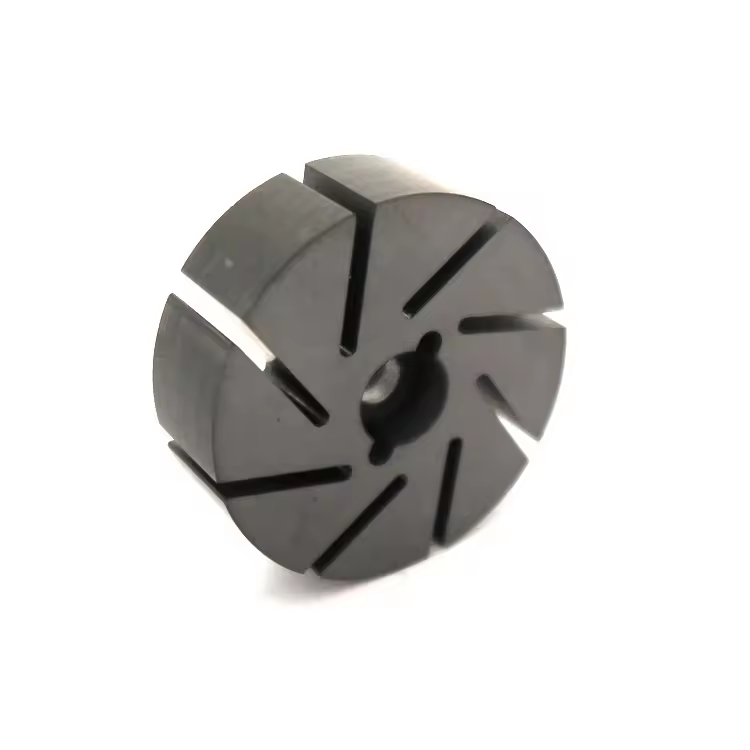
An impeller is a simple concept. It spins, it moves fluid, it creates flow and pressure. Most impellers are made from stainless steel, cast iron, bronze, or engineering plastics. Each material has a domain where it performs well and a boundary where it fails.
Stainless steel handles water, mild chemicals, and moderate temperatures. It does not handle hydrochloric acid, hydrofluoric acid, or hot sulfuric acid. Cast iron corrodes even faster. Bronze is useful in seawater but not in acids. Plastics like PVC, polypropylene, and PVDF handle many chemicals at room temperature, but they soften and deform as temperatures rise. PTFE handles almost everything chemically but lacks mechanical strength and creeps under load.
Graphite does not beat any of these materials at their best property. It is not as strong as steel. It is not as cheap as plastic. What it does is perform adequately across a range that no single alternative can cover. It resists most acids and alkalis. It handles temperatures up to several hundred degrees Celsius in oxidizing environments and higher in inert ones. It resists thermal shock. It does not contaminate the process. And it is self-lubricating, which reduces wear on bearings and seals.
Where the Material Earns Its Place
Graphite impellers appear in processes where the combination of chemistry and temperature eliminates other options. Hydrochloric acid production and handling is a classic example. Hydrochloric acid attacks stainless steel and most other metals, and it is often handled at elevated temperatures. Graphite pumps and impellers are standard in this service.
Hydrofluoric acid is another. It dissolves glass, attacks many metals, and is dangerous to handle. Graphite resists it, and graphite impeller are used in HF production and handling. Phosphoric acid, sulfuric acid at high concentrations, and mixed acid streams are all candidates for graphite equipment.
In pharmaceutical synthesis, reactors often use aggressive solvents and reagents at elevated temperatures. Contamination is unacceptable. Graphite impellers avoid both the corrosion problem and the contamination risk. In electroplating and metal finishing, plating baths are acidic, hot, and often contain abrasive particles. Graphite handles the chemistry, the temperature, and the wear.
In flue gas desulfurization at power plants, lime slurry and acidic gases create an environment that destroys standard materials. Graphite impellers are used in the pumps that circulate the slurry. In water treatment, graphite impellers handle corrosive treatment chemicals that would degrade metal components.
How They Are Made
Graphite impellers are not molded or cast. They are machined from graphite blanks using carbide or diamond tooling. Graphite is abrasive, and it wears standard tooling quickly. The machining process must be precise, because the impeller’s geometry determines the pump’s performance. Blade angle, diameter, and surface finish all affect flow and efficiency.
The graphite grade is selected based on the application. Fine-grain, high-density graphite is used where strength and precision are required. Coarser grades are used where thermal shock resistance matters more. Some impellers are impregnated with resin to seal porosity, which prevents fluid from penetrating the material. Others are impregnated with metal, such as antimony or copper, to improve strength and thermal conductivity.
Balancing is essential. An unbalanced impeller vibrates, wears bearings, and eventually fails. After machining, graphite impellers are balanced to the tolerance required for the intended operating speed. This step is not optional, especially for high-speed applications.
What Determines Whether a Graphite Impeller Is the Right Choice
The first question is always the fluid. Its chemical composition determines whether graphite is compatible and what grade is required. Its temperature determines the operating limits. Its solids content and viscosity determine the impeller design.
The second question is the operating condition. Flow rate, head pressure, and rotational speed determine the impeller geometry and the strength required. Higher speeds demand higher-strength graphite and more precise balancing. Higher pressures demand more robust designs.
The third question is the pump or mixer itself. The impeller must fit the shaft, mate with the housing, and be compatible with seals and bearings. Dimensional tolerances matter. A graphite impeller that does not fit properly will not perform, no matter how good the material is.
The fourth question is the supplier. Graphite impellers are custom components, not catalog items. The supplier must be able to machine to tight tolerances, balance the finished part, and provide documentation of material properties and dimensional inspection. For critical service, the supplier should also be able to provide performance data and references from similar applications.
Maintenance and Replacement
Graphite impellers wear over time. In clean fluids, wear is slow and the impeller may last for years. In abrasive slurries, wear is faster and replacement intervals are shorter. The wear rate depends on the fluid, the operating conditions, and the graphite grade.
Inspection is the key to avoiding unexpected failures. Impellers should be checked periodically for erosion, cracking, and loss of balance. Any impeller showing significant wear should be replaced before it fails and damages other components. Keeping a spare on hand is prudent for critical service.
The Bottom Line
A graphite impeller is a niche component for a niche set of conditions. It is not the right answer for every pump or mixer. But when the fluid is corrosive, the temperature is high, and contamination is unacceptable, graphite is often the only material that works. For engineers and operators who face those conditions, understanding what graphite impellers can do, how they are made, and how to select them is essential to keeping processes running reliably.