
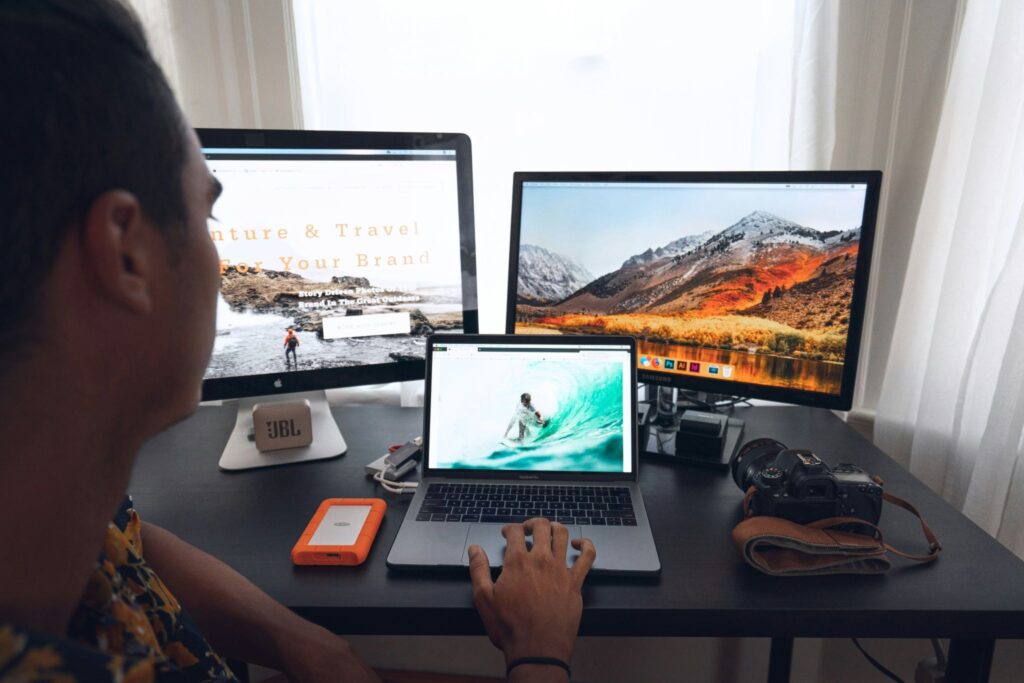
Most advice about screen time treats the workday and the evening as two separate categories. Work is when you sit at a desk and look at a monitor. The evening is supposed to be different, a break, time to unwind with your phone or a show. But for a lot of people, that separation doesn’t really exist. The screen just changes shape.
If your job already involves hours of continuous screen time, and your downtime is spent scrolling, texting, or streaming, your eyes are not getting a break at all. They’re getting the same kind of visual work in a different format. It’s a pattern worth naming, because most screen time advice never quite gets to it.
Why the Workday Alone Is Already a Lot
The average office worker spends somewhere around 1,700 hours a year in front of a screen. That number comes from research highlighted by the University of Wisconsin’s Department of Ophthalmology and Visual Sciences, and it’s worth sitting with for a second. It’s not just the hours that matter, though. Staring at a screen changes how often people blink, cutting the normal blink rate by roughly a third to a half. Less blinking means less moisture on the surface of the eye, which is a big part of why eyes feel dry, gritty, or tired by the afternoon.
That’s before anything happens in the evening. A full workday of screen use on its own is already enough to bring on symptoms for a lot of people. Eye care providers commonly note that discomfort tends to start somewhere in the two to three hour mark of continuous screen use, and a full workday runs well past that.
The Part Nobody Names: There’s No Recovery Window
Here’s the piece that tends to get skipped. When the workday ends, the natural assumption is that screen exposure ends too. In practice, a lot of people go straight from a laptop to a phone, then to a tablet or a TV. The visual system doesn’t get a chance to recover before the next round of exposure starts.
A recent survey from VSP Vision Care, conducted with the research firm Workplace Intelligence, found that most workers report screen-related eye strain is affecting their job performance, with a meaningful amount of lost productivity showing up across a typical week. That data point is specifically about the work side of the equation. Add an evening of recreational screen use on top of it, and the exposure adds up in a way that most people never actually track.
Building in a real recovery window, even something as small as twenty or thirty minutes of genuinely screen free time between the end of work and the start of evening scrolling, gives the eyes a chance to reset before the next stretch begins. A walk, cooking, or just sitting outside for a bit all count. The point isn’t to eliminate screens. It’s to interrupt the continuous stretch.
For people whose evening screen use isn’t going anywhere realistic, a small adjustment like blue light glasses can be a low effort piece of that routine, worn during the second half of the day when total exposure is already stacking up. They’re not a fix for the underlying pattern, but they’re an easy thing to add without requiring a change in habits that most people aren’t going to make anyway.
A Word on What Blue Light Glasses Actually Do
It’s worth being straightforward about this. The American Academy of Ophthalmology has pointed out that some research finds blue light filtering lenses aren’t dramatically effective on their own, and that behavior around screen use matters more than the small amount of blue light screens actually emit. That’s a fair point, and it’s better to say it plainly than to oversell the glasses as a solution to something they can’t fully solve.
Where they do make sense is as one small, easy piece of a broader approach, alongside actual behavior changes like breaks and blink reminders. Nobody needs to treat them as a cure. They’re a low friction option for people who know their screen habits aren’t changing overnight and want to reduce one part of the strain in the meantime.
Small Changes That Actually Help
A few practical adjustments make a real difference without requiring anyone to give up their evening scrolling entirely.
Applying the 20-20-20 rule (looking at something twenty feet away for twenty seconds every twenty minutes) during evening screen use, not just at a work desk, helps interrupt the same continuous focus that causes strain during the day.
Turning down brightness and increasing contrast on phones and laptops in the evening is a free, immediate change that reduces glare without changing what someone is actually doing on the device.
Swapping the last hour before bed for audio or a physical book instead of a phone gives the eyes an actual endpoint to the day’s screen exposure, rather than letting it run right up until the moment someone falls asleep.
None of these require treating screen time as a problem to be solved all at once. They’re small adjustments aimed at the specific gap that gets missed: the total exposure across a full day, not just whatever happens between nine and five.
The Bigger Point
Nobody needs to feel like they’re doing something wrong by scrolling in the evening after a screen heavy workday. That’s just how a lot of days are structured now. The more useful shift is recognizing that work screens and evening screens add up to one continuous stretch of visual demand, and building in small breaks, habit changes, or tools that account for that total, rather than treating the workday and the evening as if they’re unrelated.