
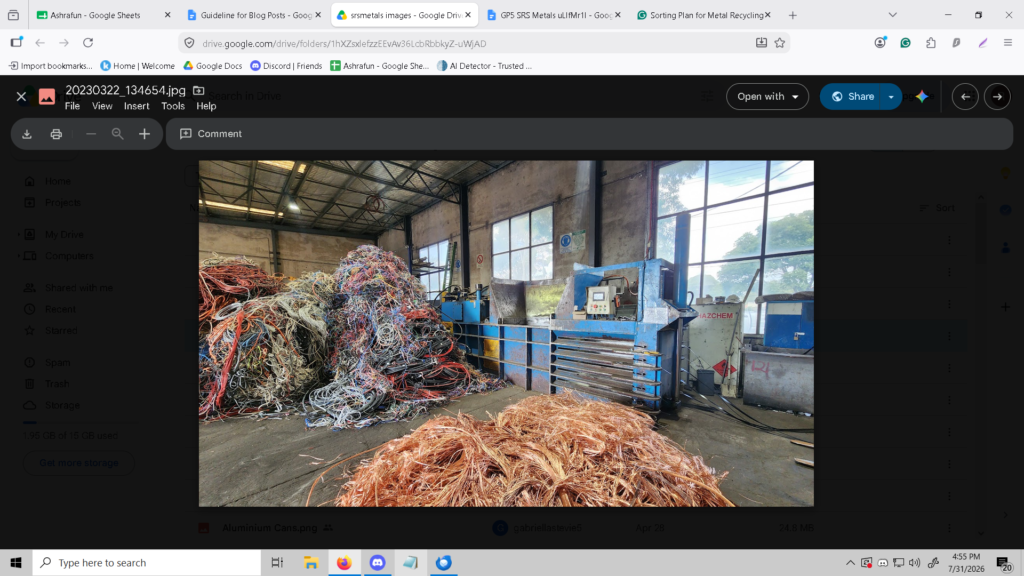
Metal recycling looks simple until you try to run it on a busy commercial site. Then the questions start. Where does the copper go? Who separates the steel offcuts from the mixed grades? What happens when the pile grows faster than anyone can move it? A working setup answers all of that before the first load builds up.
Get the containers and the sorting right, and metal recycling stops being a headache and starts paying you back. Get it wrong, and you lose money on every skip that leaves the yard. Most sites already generate more scrap value than the operators realise. The problem is rarely the material. It is the system around it.
A construction site with no sorting plan will watch clean copper get buried under general waste, and clean copper is worth far more than the mixed rate. So the setup matters. Let us break it down.
Why Your Site Needs a Sorting Plan First
Before any container arrives, you need to know what your site produces. A demolition job throws off different metals than a fabrication workshop. A factory clearing old plant equipment has different volumes again.
Ask yourself three things:
- What metals come off this site, and in what rough quantities?
- How much space can you give to storage without blocking work?
- How often will the containers need collecting?
Answer those, and the rest of the plan almost writes itself. Skip this step, and you end up with the wrong bins in the wrong spots, which slows everyone down.
Here is the part people miss. Mixed metal pays less. When ferrous and non-ferrous grades sit together, the whole load drops to the lower rate. Separate them at the source, and the numbers climb. That is the difference between metal recycling that funds a job and metal recycling that barely covers the haulage.
Choosing Between Bins, Cages and Bulka Bags
Not every container suits every job. The right choice depends on the metal type, the weight and how you plan to move it.
Skip bins and hook-lift bins handle heavy, high-volume work. Think steel beams, old machinery, bulk ferrous scrap from a demolition. SRS Metals runs a fleet built for exactly this, including bins large enough for construction-scale loads.
Cages work well for loose non-ferrous material that needs to stay contained and visible. Copper, brass, aluminium offcuts. You want these grades kept clean and away from contamination, so a cage keeps them sorted and easy to check.
Bulk bags suit lighter or smaller-volume streams. They are simple, they store flat until needed, and they let you separate a minor grade without committing a whole bin to it.
A mid-size site often runs all three at once. One bin for ferrous, a cage for copper, a bag or two for the odd grades. That spread keeps every stream clean, and clean streams pay more. Perhaps the simplest rule is this. One metal, one container, no mixing.
How a Baler Changes the Maths on Larger Loads
Loose scrap wastes space. A pile of light metal fills a bin fast while weighing very little, which means you pay to move air. Baling solves that problem.
SRS Metals runs a mobile car baler that comes to your site to bale cars and metal on the spot. For yards clearing vehicles or large volumes of body metal, that saves the cost and hassle of transporting loose material first. The metal gets compressed where it sits, then moved once, already dense and ready for recycling.
I think the on-site angle is what people underrate. Every extra handling step costs time and money. Bring the baler to the metal, and you cut the steps down. Fewer trips, less labour, tighter loads.
What Your Site Should Not Try to Do
A quick word on limits, because it saves confusion later. SRS Metals collection is built for large commercial and construction sites. It is not a household service.
If the load is small, or it is general household metal, the cost-effective route is drop-off. Bring it directly to a yard. In some cases, smaller loads may need a hired truck to transport, and that is normal for one-off clearances. The collection fleet exists for volume, so matching the right service to the right job keeps everyone efficient and keeps your rates fair.
That distinction matters when you plan a site. Do not build a setup expecting a truck for every minor offcut. Build it around the volume you actually produce, and use drop-off for the rest.
Turning Your Setup Into Steady Returns
Once the containers are in place and the sorting habit sticks, metal recycling runs quietly in the background. The crew learns where each grade goes. The bins fill cleanly. Collections get booked before anything overflows.
Wrapping Up
Ready to set up scrap collection or drop-off for your commercial or construction site? Talk to SRS Metals about the right bins, cages, bags and baling for your volumes. Reach the team at enquiries@srsmetals.com.au and get your site sorted properly.