
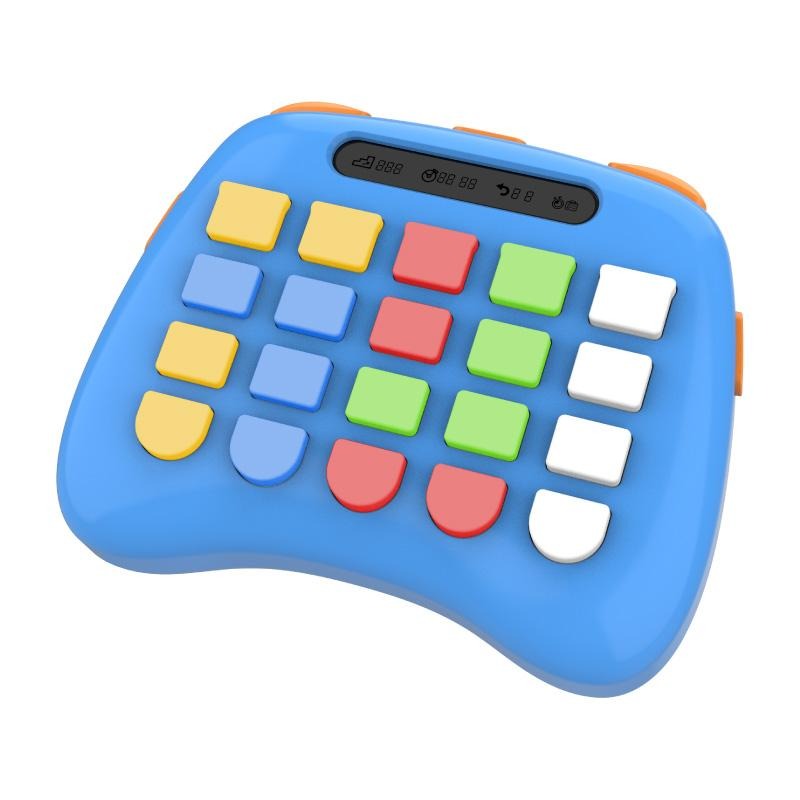
Every generation of parents faces a version of the same debate: the new thing versus the classic. Today it is the electronic logic toy against the wooden puzzle, the brain-teaser box against the app-free challenge. Grandparents swear by the classics; kids beg for the lights and sounds. The honest answer is that both have real strengths — and the smartest choice depends on what you are trying to build.
Where Traditional Puzzles Win
Give the classics their due. A physical jigsaw or wooden brain-teaser develops fine motor skills and spatial reasoning in ways no button-pressing can match. There is no battery to die mid-session, no planned obsolescence, and the good ones get handed down to grandchildren. Traditional puzzles also create natural social play — siblings hunched over a table together, arguing cheerfully about which piece goes where. And at their best, they teach patience: some problems simply take time, and that lesson transfers everywhere. For tactile development and quiet focus, the classics remain undefeated.
Where an Electronic Logic Toy Pulls Ahead
But traditional puzzles have a hard ceiling: once solved, they are solved. An electronic logic toy randomizes challenges, escalates difficulty, and tracks progress — which means it stays in the productive struggle zone far longer. The instant feedback loop is the killer feature: a child learns in seconds what took minutes of adult guidance with a static puzzle. For working memory and processing speed — holding a sequence in mind while acting fast — electronics train skills that cardboard simply cannot reach. And crucially, the toy adapts: it gets harder as the child gets better, something no fixed puzzle can do.
Independence is the other major edge. An electronic logic toy lets a child practice productively without an adult present, which in real households is often the difference between practice happening and not happening.
The Attention Question, Answered Honestly
Critics say electronics shorten attention spans. The evidence is more nuanced: passive screen consumption fragments attention, but active problem-solving builds it. A child concentrating on a timed logic sequence is practicing sustained focus, not losing it. The risk is not the electronics — it is badly designed electronics that reward button-mashing over thinking. That is a product quality issue, not a category problem. Choose a well-designed electronic logic toy with genuine challenge progression, and you are building attention, not eroding it.
Cost and Longevity Compared
Upfront, traditional puzzles are cheaper — often dramatically so. But measure cost per engaged hour and the picture shifts. A $15 puzzle completed twice costs $7.50 per session. A $45 electronic logic toy played for a hundred hours costs $0.45 per session. Longevity also favors electronics when they are well made: progressive levels mean the same toy serves a six-year-old and, a year later, the same child at a harder setting. The classics win on simplicity and heritage; electronics win on sustained engagement per dollar.
The Verdict Most Parents Land On
Ask parents who own both and you will hear the same conclusion: it was never either-or. Traditional puzzles for quiet table time and tactile skills; an electronic logic toy for independent practice, speed, and progression. They train overlapping but distinct abilities, the way running and swimming both build fitness differently. If you must pick one, pick based on your child’s gap: a restless kid who needs focus practice benefits most from electronics with timed challenges; a screen-saturated kid benefits most from the slow satisfaction of wood and cardboard. Either way, the goal is the same — a child who loves the feeling of figuring things out.
What Teachers Actually Recommend
Ask classroom teachers and you will hear a pragmatic take: they want both, used differently. Traditional puzzles earn their place in quiet corners and morning warm-ups — low setup, no charging, naturally collaborative. But when teachers need twenty kids productively occupied at different levels, an electronic logic toy wins on pure logistics: self-paced, self-checking, and quiet enough not to disrupt the next table.
The teacher test is also a quality filter. Products that survive classroom use — dozens of children daily, minimal supervision — are built to a standard no home toy needs to meet. If an electronic logic toy has real traction in schools, that is one of the strongest durability signals a parent can find. And when homework time comes, the child who has been practicing logic play all year approaches word problems with noticeably more patience.
The bottom line for busy parents: you do not need to overthink this. Keep a traditional puzzle on the table for quiet moments and an electronic logic toy charged for independent play, and your child gets the best of both worlds. Watch what they reach for, follow their curiosity, and adjust. The right mix is the one your child actually uses — everything else is just packaging.