
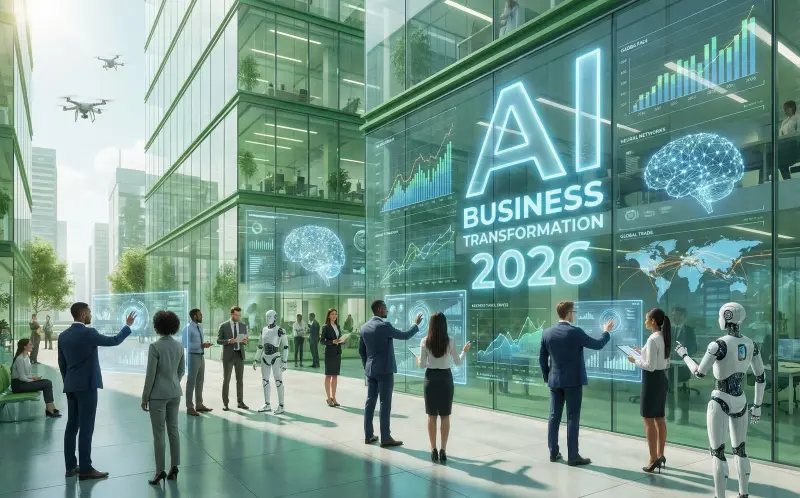
Introduction: The Year Mobile Hit Its Inflection Point
In February 2026, a small business owner in Mumbai named Priya Sharma did something that would have been unthinkable just two years earlier. While waiting for her flight at Chhatrapati Shivaji Maharaj International Airport, she pulled out her smartphone, opened an app called Emergent, and spoke a simple command: “Build me a mobile app that manages inventory for my clothing boutique, syncs with my suppliers, and sends me low-stock alerts.” Within minutes, the AI had generated a fully functional, production-ready application. By the time her flight landed in Delhi, the app was published on the Google Play Store .
This scene, once the stuff of science fiction, represents the new reality of business in 2026. Artificial intelligence has fundamentally rewired the mobile ecosystem—not incrementally, but seismically. The data tells a stark story: AI-powered apps doubled their downloads to 3.8 billion in 2025, while in-app purchase revenue nearly tripled to exceed $5 billion . More tellingly, non-gaming app revenue surpassed gaming revenue for the first time in mobile history, climbing 21% year-over-year to reach $167 billion globally .
But these numbers, impressive as they are, only hint at the deeper transformation. AI is not merely another feature category in app stores. It is becoming the operating principle of mobile business itself—reshaping how companies engage customers, how they build software, how they acquire users, and ultimately, how they define their relationship with the people they serve.
This article examines the three fundamental ways AI-powered mobile apps are driving business growth in 2026: through hyper-personalized engagement, through the democratization of software creation, and through a looming structural shift that may upend the app economy entirely.
Part I: The Engagement Revolution—AI That Knows You Before You Do
From Reactive to Predictive: The New Customer Relationship
For the first decade of the mobile era, “personalization” meant showing users content vaguely related to their past behavior. An e-commerce app might recommend products based on previous purchases. A music app might surface songs in genres you had streamed. This was, at best, retrospective intelligence—a rearview mirror approach to understanding customers.
2026 has rendered that model obsolete.
The new generation of AI-powered apps operates predictively rather than reactively. Instead of waiting for users to signal intent through clicks and purchases, these apps model future behavior before it happens. Platforms like Mixpanel, Singular, and Liftoff now offer predictive lifetime value (LTV) scoring that estimates a user’s long-term worth within seconds of their first session . This allows businesses to make instantaneous decisions about how much to spend acquiring a user—and whether that user belongs in a high-touch engagement funnel or a low-cost retention track.
The implications for business growth are profound. When you know which users are likely to convert, which are likely to churn, and which are likely to become high-value advocates, you stop marketing to segments and start marketing to individuals at scale. One platform, CleverTap, describes this evolution through a “3I framework”: experiences must be Interactive (responding to real-time behavior), Immersive (augmenting user intent rather than interrupting it), and Inconspicuous (arriving at precisely the right moment without feeling intrusive) .
The Rise of AI Assistants: From Novelty to Utility
The poster child for this engagement shift is ChatGPT, which in 2025 became the second-most-downloaded app globally, trailing only TikTok . Its growth trajectory defies conventional software economics: downloads surged 148% year-over-year, in-app purchase revenue jumped 254%, and perhaps most importantly, total time spent exploded by 426% .
This last metric—time spent—is the critical one. It signals that users have moved beyond experimentation into habitual use. They are not just testing ChatGPT; they are integrating it into their daily workflows, both personal and professional. In the United States alone, ChatGPT became the ninth most-used app among men in Q4 2025 . Among the top ten AI assistants, mobile users now exceed 110 million, compared to just 13 million in early 2024 .
What drives this engagement is the shift from simple Q&A to agentic functionality. Users now expect AI assistants to do things, not just answer questions. They book travel through Expedia within ChatGPT. They order food via DoorDash through conversational interfaces. They manage subscriptions, track packages, and schedule appointments without ever opening a dedicated app .
For businesses, this presents both opportunity and existential challenge. The opportunity is reach: AI assistants represent a new distribution channel, potentially more intimate and more frequent than traditional apps. The challenge is control: when the assistant becomes the primary interface, the business risks becoming invisible infrastructure rather than a branded destination.
The Attention Economy Intensifies
Despite AI’s explosive growth, social media still commands the lion’s share of mobile attention. Consumers spent nearly 2.5 trillion hours on social apps in 2025, averaging more than 90 minutes per day per user . But the growth rates tell a different story. While social media time increased 5%, AI assistant time skyrocketed 426% .
This divergence captures the essence of the 2026 mobile market: a mature, saturated ecosystem where overall downloads are flat (up just 0.8% to nearly 150 billion) but where revenue continues to climb . The battle is no longer for new users—most markets have reached saturation. The battle is for attention, and AI is proving uniquely capable of capturing it.
For businesses, the takeaway is clear: growth now depends less on acquiring masses of new users and more on deepening engagement with existing ones. The companies winning in 2026 are those using AI to make every interaction count—to anticipate needs before they are articulated, to reduce friction to zero, and to transform utility into loyalty.
Part II: The Creation Revolution—When Everyone Becomes a Builder
Collapsing the Cost of Software
If engagement represents the demand side of the AI transformation, software creation represents the supply side. And here, the numbers are even more staggering.
Consider Emergent, an AI-powered app-building platform founded in 2025 by Indian-origin twin brothers Mukund and Madhav Jha. In just eight months since launch, Emergent crossed $100 million in annual recurring revenue—at one point doubling revenue within 30 days . It now counts six million builders across 190 countries, who have created more than seven million apps .
What explains this hyper-acceleration? A brutal reset of software economics.
Traditionally, a small business looking to digitize its operations would approach a development shop and spend $500,000 or more to build custom software. On Emergent, the same business can ship a first version for $1,000 to $5,000 . This price collapse has unlocked an entirely new market: people who were priced out of software development can now participate as builders.
“This is a market that didn’t exist earlier,” says Mukund Jha, Emergent’s CEO. “People who would never have built software are now entering the economy as builders” .
Mobile-First Development
The crucial inflection point came in early 2026, when Emergent launched its mobile app-building platform in beta. For the first time, users could create, download, and publish apps directly to app stores using nothing but their smartphones .
Within weeks, the mobile product was contributing 8–10% of overall revenue growth. Demand has been particularly strong among users who want to build on the go—or who don’t have access to laptops at all. The ability to start by voice (“Build me a mobile app that…”), continue seamlessly between mobile and desktop, and publish production-ready software from anywhere has turned smartphones into full-fledged app factories .
This matters because it fundamentally expands who gets to build. Ninety-one percent of American adults own a smartphone. Globally, billions of people carry devices more powerful than the computers that sent humans to the moon. By putting app creation on those devices, platforms like Emergent are democratizing not just software consumption, but software production.
The Long Tail of Business Digitization
The implications for business growth are profound. Small and medium enterprises—the backbone of every economy—have historically been underserved by traditional software vendors. The economics simply didn’t work. A $500,000 custom build was out of reach for a local retailer; a $50,000 annual SaaS subscription was too expensive for a solo consultant.
AI-powered development platforms collapse these economics. A boutique owner can now build inventory management software tailored to her specific workflow. A personal trainer can create a client scheduling app with custom workout logging. A restaurant can deploy a ordering system that integrates with its existing kitchen operations—all for a few thousand dollars and a few hours of time .
This is not low-code or no-code as previously understood. Those tools still required technical understanding: knowledge of data structures, logic flows, and API integrations. The new generation of AI development tools requires only intent. You describe what you want, and the AI builds it. The technical layers become invisible.
For the broader economy, this means a wave of digitization from the bottom up. The long tail of businesses that remained analog because software was too expensive or too complex can now join the digital economy. And because these businesses are building their own tools, adoption friction disappears. Software built for your exact workflow requires no training, no adaptation, no compromise.
Part III: The Acquisition Revolution—AI-Driven User Growth
Predictive Segmentation in Production
As AI reshapes engagement and creation, it is also fundamentally altering how businesses acquire users. The days of broad demographic targeting and rules-based segmentation are ending. In their place, AI-driven predictive segmentation has moved from pilot projects to production deployment .
Leading mobile attribution and analytics platforms—including Mixpanel, Singular, CleverTap, Liftoff, and Kochava—now offer machine learning models that estimate user value before traditional signals become available . These models combine multiple predictive signals:
- Propensity models estimate likelihood of install, conversion, or engagement
- LTV and revenue prediction prioritize users based on expected long-term value
- Churn risk models identify low-retention cohorts before they drop off
- Lookalike expansion scales high-value audiences efficiently
The result is user acquisition that operates on probability rather than certainty. Instead of waiting to see which users convert, businesses can now predict conversion and allocate budget accordingly.
Autonomous Decisioning
The next frontier, already visible in 2026, is autonomous decisioning. Platforms are moving beyond recommendations toward systems that automatically adjust bids, reallocate budgets, and optimize creative in real-time without human intervention .
Liftoff’s Director of Product for Machine Learning, Benjamin Young, describes the shift: “Fully ML-driven targeting is essential to ensure the best advertiser outcomes in today’s environment. Optimal budget allocation is not a result of coarse segmentation, but rather a result of many user-level decisions coming from well-calibrated predictive models” .
This autonomy addresses a growing challenge in mobile user acquisition: rising costs, weaker attribution signals, and fragmented user data have made manual optimization nearly impossible. When performance can swing unpredictably based on tiny changes to targeting or bids, human reaction times are simply too slow. AI systems that continuously recalculate user value and adjust strategy in milliseconds become not just advantageous, but essential.
The Privacy-Compliant Advantage
Notably, AI-driven acquisition is proving more resilient to privacy changes than traditional methods. As Apple’s App Tracking Transparency and similar regulations have weakened deterministic attribution, platforms that rely on probabilistic modeling and first-party data have gained advantage .
By estimating user value from behavioral signals rather than depending on cross-app tracking, AI systems can maintain effectiveness even as identifiers become restricted. This privacy-compliant approach is becoming table stakes for growth in 2026.
Part IV: The Looming Disruption—Agentic AI and the Future of Apps
The Galaxy S26 Moment
Just as businesses are mastering the current AI landscape, the ground is shifting beneath them. In February 2026, Samsung unveiled the Galaxy S26, marketed as an “agentic AI phone.” The device integrates multiple AI agents at the operating system level, capable of acting across apps and orchestrating multi-step workflows on a user’s behalf .
This represents a fundamental change in the unit of mobile interaction.
For the past 15 years, that unit has been the app. If you wanted something done, you opened a specific vendor’s environment. Transportation meant Uber. Travel meant Expedia. Music meant Spotify. Banking meant your bank’s portal.
The agentic phone changes this. Interaction begins with intent rather than app selection. You state what you want—”Order my usual sushi”—and the operating system agent determines how to accomplish it .
At present, the agent still calls Uber or DoorDash. The app remains in the transaction chain. But it fades into the background, becoming infrastructure rather than interface. And once software becomes plumbing, its permanence is no longer guaranteed.
The Middle Layer Question
This raises an uncomfortable question for app developers: If the OS agent can talk directly to merchants, why does the chain need to flow through your app?
Consider the near-future scenario described by technology analyst Tom Snyder. You say, “Order my usual sushi.” Your phone’s AI agent places a direct call to the restaurant. The restaurant answers with its own AI system. The two agents authenticate one another, confirm inventory, adjust timing, finalize payment, and log the order. No delivery marketplace. No third-party interface. No app icon touched .
Every building block for this scenario already exists. Restaurants are deploying AI phone systems. Voice models improve quarterly. Edge compute grows more capable. Payment and identity are embedded at the OS level. The only missing piece is the business model that makes it work—or, perhaps, the willingness of platform owners to cannibalize their own app economies.
Platform Tensions Emerge
The tension is already visible. When Rabbit, the startup behind the R1 device, sought API access from Uber to enable direct ride-hailing, Uber declined. “You have to understand why they’re not super happy: They sell fucking advertisements,” Rabbit’s CEO Jesse Lyu told WIRED. “That’s where many of them make money” .
Perplexity encountered similar resistance when Amazon sued over its shopping agent, demanding the startup stop scraping its site .
Yet some larger platforms are cooperating. DoorDash, Instacart, and Expedia have built early AI apps within ChatGPT. Ticketmaster, Uber, and OpenTable debuted as agentic features for Alexa+ . The pattern suggests that scale matters: large platforms may partner with large AI providers, while smaller developers face exclusion.
The Unanswered Question
Qualcomm CEO Cristiano Amon captured the direction in his Mobile World Congress keynote: “We will go from a digital ecosystem centered on the smartphone and centered on the app to one centered on the agent. The agent becomes the center. It’s not just responding to you—it’s observing, interpreting, and acting” .
For businesses built on the app economy, this presents an existential question. If agents become the primary interface, who owns the customer relationship? Who captures the data? Who serves the upsells? Who builds the loyalty?
The answers remain unsettled. Anjney Midha, an investor and board member at AI device startup Sesame, notes: “This is something that every major AI platform is wrestling with today: They all want to make their platform super useful, but how do you pay for it?” .
The ad model that funded the web and the app store model that funded mobile may not translate to an agentic world. New economic agreements will need to emerge. And the businesses that thrive will be those that position themselves not just as app providers, but as essential services that agents cannot bypass.
Conclusion: Three Transformations, One Trajectory
The story of AI-powered mobile apps and business growth in 2026 is really three stories unfolding simultaneously.
The first is a story of deepening engagement. AI assistants have moved from novelty to utility, capturing 480 billion hours of user attention and reshaping how customers interact with businesses. Predictive personalization has made every interaction count, transforming reactive marketing into anticipatory service.
The second is a story of democratized creation. Platforms like Emergent have collapsed software development costs from hundreds of thousands of dollars to thousands, enabling millions of new builders to enter the digital economy. Small businesses that were priced out of custom software can now build exactly what they need, exactly when they need it.
The third is a story of looming disruption. Agentic AI threatens to hollow out the app economy, reducing branded destinations to invisible infrastructure. The battle between platform owners, app developers, and AI providers over who controls the customer relationship is only beginning.
Together, these transformations point to a single trajectory: AI is not just another feature category in mobile. It is becoming the substrate on which mobile experiences are built. The apps that win in 2026 and beyond will be those that embrace this reality—that use AI not as an add-on but as architecture, that build for a world where intent supersedes icons, and that recognize that the ultimate business growth comes not from controlling the interface, but from being indispensable to the outcome.
Priya Sharma, the Mumbai boutique owner building apps from airport departure lounges, represents both the present and the future. She is a consumer of AI-powered tools and a producer of AI-built software. She is the customer that businesses seek to engage and the competitor that incumbents must respect. And she is, above all, a sign of what happens when technology finally bends to human intent rather than the other way around.
That is the transformation of 2026. And it is only the beginning.