
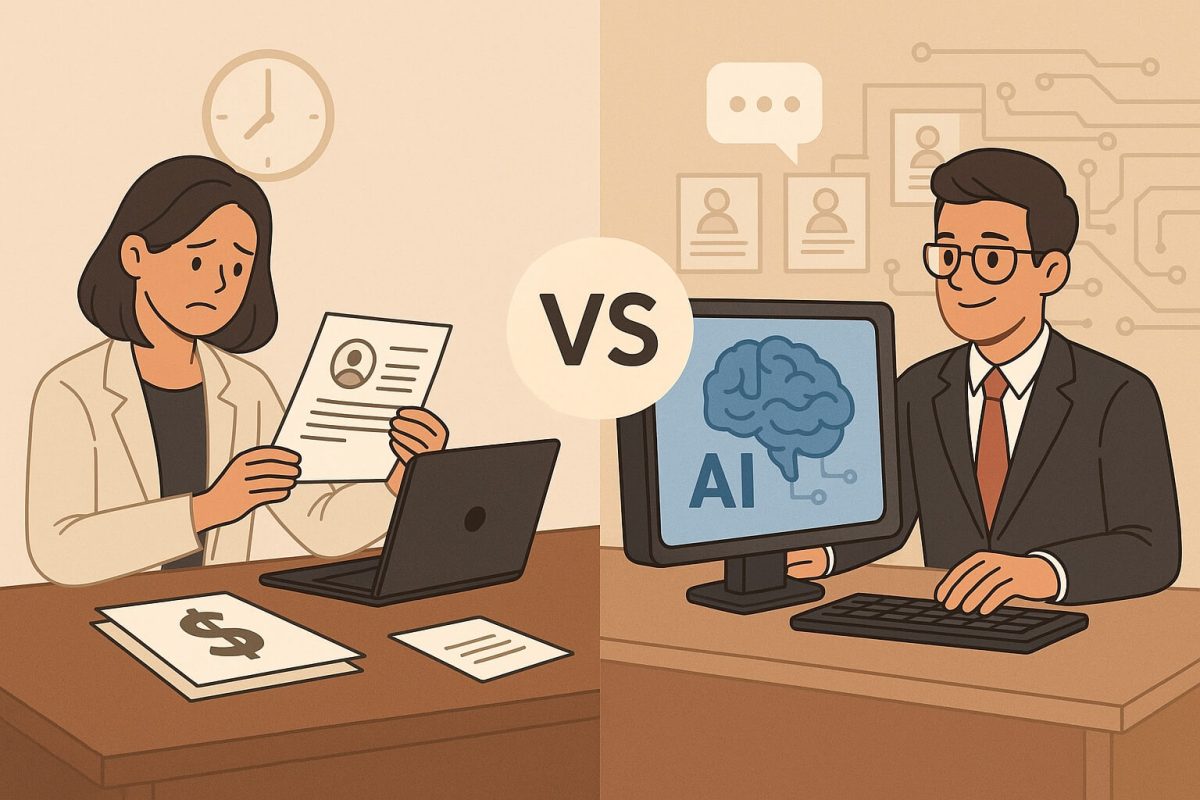
High-volume hiring creates a unique challenge for recruiting teams. While attracting applicants is rarely the problem, identifying qualified candidates from hundreds or even thousands of resumes often becomes the real bottleneck.
Recruiters handling frontline hiring, graduate recruitment, seasonal staffing, customer support expansion, or rapidly growing technical teams frequently spend more time filtering applications than engaging with candidates. The administrative burden increases further when hiring managers expect shortlists quickly and open positions remain vacant for extended periods.
This pressure has pushed many organizations toward automation, particularly resume screening technology. Over the last few years, a growing number of free AI recruiting tools have entered the market, promising faster screening, reduced manual effort, and improved candidate matching.
However, not every solution performs the same way in high-volume environments.
Some systems prioritize speed. Others focus on candidate ranking accuracy. Certain platforms offer strong integrations, while others create additional workflow complexity. Understanding these differences is critical for recruiting teams that need practical outcomes rather than impressive feature lists.
Why resume screening becomes a bottleneck at scale
A recruiter reviewing 50 resumes for a specialized role can usually apply human judgment effectively.
The situation changes dramatically when application volumes exceed several hundred candidates per position.
High-volume recruitment environments often include:
- Customer service hiring
- Retail recruitment
- Healthcare staffing
- Graduate programs
- Warehouse operations
- BPO recruitment
- Large-scale technology hiring
In these scenarios, recruiters face several operational challenges:
- Repetitive resume reviews
- Inconsistent qualification assessments
- Delayed candidate responses
- Hiring manager pressure
- Screening fatigue
- Extended time-to-shortlist metrics
Manual review remains valuable, but the process becomes increasingly difficult to sustain as applicant numbers rise.
This is where modern AI hiring tools are frequently introduced into the recruitment process.
The primary approaches used by AI resume screening systems
Not all resume screening technologies evaluate candidates in the same manner.
Understanding how different systems operate helps recruiters select tools that align with their hiring objectives.
Keyword and rule-based screening
Many entry-level platforms still rely heavily on keyword matching.
These systems compare resumes against predefined criteria such as:
- Skills
- Certifications
- Education requirements
- Job titles
- Industry experience
The advantage is predictability.
Recruiters understand why candidates are shortlisted because the screening criteria are explicit.
The drawback is rigidity.
Strong candidates can be overlooked if their resumes use alternative terminology or unconventional career descriptions.
Semantic matching models
More advanced AI resume screener platforms analyze context rather than exact keyword matches.
Instead of searching solely for specific phrases, these systems attempt to understand relationships between skills, responsibilities, and experience.
For example, a candidate with experience managing Kubernetes infrastructure may still rank highly for a cloud engineering role even if the job description emphasizes container orchestration rather than Kubernetes specifically.
This broader interpretation often improves candidate discovery.
However, it also introduces occasional ranking inconsistencies that recruiters must validate.
Predictive scoring systems
Some vendors use predictive models that generate candidate fit scores.
These systems evaluate historical hiring patterns and attempt to identify applicants who resemble previously successful employees.
The potential benefit is greater screening efficiency.
The challenge is maintaining transparency.
Recruiters may struggle to explain why one candidate receives a higher score than another when the underlying logic is difficult to interpret.
For organizations operating in highly regulated hiring environments, explainability remains an important consideration.
Key evaluation criteria for high-volume hiring teams
The effectiveness of screening technology depends less on marketing claims and more on operational performance.
Recruiters evaluating free AI recruiting tools should focus on practical criteria.
Screening accuracy
The first question should always be straightforward:
Does the tool consistently surface qualified candidates?
A system that reduces review time but overlooks strong applicants creates a larger problem than it solves.
Accuracy should be measured through:
- Quality of shortlisted candidates
- Hiring manager satisfaction
- Interview-to-offer ratios
- Candidate progression rates
Processing speed
High-volume recruiting often involves strict hiring deadlines.
Whether filling seasonal roles or supporting rapid growth initiatives, recruiters need systems capable of handling large application volumes quickly.
Fast processing becomes particularly important during:
- Campus hiring campaigns
- Job fair recruitment
- Bulk hiring projects
- National recruitment drives
Workflow integration
Even effective screening technology can create friction if it operates separately from existing systems.
Recruiters typically manage hiring activities through ATS platforms, sourcing tools, communication systems, and reporting dashboards.
When evaluating AI hiring tools, integration capabilities deserve close attention.
Poor integrations often create:
- Duplicate candidate records
- Manual data transfers
- Inconsistent reporting
- Additional recruiter workload
Candidate ranking transparency
Recruiters need confidence in automated recommendations.
The strongest systems provide visibility into ranking decisions rather than presenting unexplained scores.
Transparency helps teams:
- Validate recommendations
- Address hiring manager concerns
- Maintain compliance requirements
- Reduce decision-making risk
Comparing common categories of AI recruiting tools
The market now includes several distinct categories of screening technology.
Each serves a different purpose within high-volume recruitment operations.
Standalone resume screening platforms
These solutions focus primarily on candidate evaluation.
Strengths typically include:
- Sophisticated screening models
- Flexible ranking criteria
- Detailed candidate comparisons
Limitations may include:
- Separate workflows
- Additional integrations
- Reporting fragmentation
Recruiters often benefit from these tools when hiring volume justifies dedicated screening functionality.
ATS-native screening capabilities
Many applicant tracking systems now include embedded AI screening features.
This approach keeps screening within existing recruiter workflows.
Advantages include:
- Unified candidate records
- Reduced implementation complexity
- Consistent reporting
A practical example can be seen in platforms such as Recruit CRM, where AI-assisted recruitment functionality is incorporated within broader ATS and CRM workflows rather than functioning as an isolated screening product.
For recruiters, this often reduces context switching between systems.
Enterprise talent intelligence platforms
These solutions combine screening with broader workforce analytics capabilities.
They may support:
- Internal mobility
- Succession planning
- Talent mapping
- Workforce forecasting
While powerful, these systems are often more relevant for large organizations with extensive hiring infrastructure.
Smaller recruiting teams may find them unnecessarily complex for straightforward screening needs.
Common limitations recruiters should expect
AI-assisted screening can improve efficiency, but recruiters should approach implementation realistically.
Several limitations remain common across many platforms.
Resume quality still influences outcomes
AI cannot fully compensate for poor resume formatting or incomplete information.
Candidates who fail to document relevant experience clearly may still receive inaccurate rankings.
Recruiters should recognize that screening results reflect both candidate qualifications and resume quality.
Niche hiring remains challenging
Specialized roles often require deeper contextual understanding.
Executive hiring, highly technical positions, and emerging skill categories frequently benefit from recruiter judgment alongside automated screening.
Human review remains important when evaluating nuanced experience.
Historical bias considerations
Organizations should carefully examine how screening models are trained.
Systems relying heavily on historical hiring patterns may unintentionally reinforce previous recruitment preferences.
Responsible implementation requires ongoing monitoring and validation.
Hiring manager expectations
Some hiring managers assume AI screening automatically improves candidate quality.
In reality, screening technology primarily improves efficiency.
The quality of hiring outcomes still depends on:
- Job description accuracy
- Evaluation frameworks
- Interview processes
- Decision-making consistency
Technology supports these activities rather than replacing them.
Measuring screening success after implementation
Introducing an AI resume screener should produce measurable operational improvements.
Without clear metrics, determining effectiveness becomes difficult.
Recruiters often monitor the following indicators.
Time-to-shortlist
One of the clearest measurements is how quickly recruiters generate qualified candidate lists.
Reduced review time often signals immediate operational value.
Candidate quality metrics
Recruiters should compare:
- Interview conversion rates
- Offer acceptance rates
- Hiring manager satisfaction scores
These indicators help determine whether screening quality improves alongside efficiency.
Recruiter productivity
Productivity gains may appear through:
- Increased requisition capacity
- Faster response times
- Reduced administrative workload
When screening automation works effectively, recruiters spend more time engaging candidates and less time reviewing resumes manually.
Candidate experience outcomes
Faster screening frequently contributes to better candidate experiences.
Applicants appreciate:
- Quicker responses
- Faster interview scheduling
- Reduced application delays
These improvements can positively influence employer brand perception.
Choosing between free and paid screening solutions
Many recruiting teams begin their evaluation process with free AI recruiting tools.
This approach offers several advantages.
Teams can:
- Test workflows
- Validate use cases
- Assess recruiter adoption
- Understand integration requirements
However, free solutions often introduce limitations such as:
- Candidate volume restrictions
- Basic reporting
- Limited integrations
- Reduced customization options
For smaller recruiting teams, these constraints may be acceptable.
For organizations managing thousands of applicants monthly, scalability becomes increasingly important.
The decision should ultimately depend on operational requirements rather than software pricing alone.
A free solution that creates manual work may become more expensive over time than a paid platform that supports efficient hiring operations.
Where human judgment continues to matter
Despite rapid advances in automation, recruiting remains fundamentally people-driven.
Technology can identify patterns, rank candidates, and reduce administrative effort.
It cannot fully assess:
- Career motivations
- Cultural contribution
- Leadership potential
- Stakeholder alignment
- Long-term growth capacity
The strongest hiring teams use AI hiring tools to support recruiter decision-making rather than replace it.
Screening automation handles repetitive tasks while recruiters focus on evaluation, relationship building, and strategic hiring decisions.
This balance becomes especially important in high-volume recruitment environments where speed matters, but hiring quality remains the ultimate objective.
Conclusion
Resume screening sits at the center of many high-volume hiring challenges. As application volumes continue to increase, recruiters need efficient ways to identify qualified candidates without creating delays or sacrificing hiring quality.
Different AI recruiting tools approach screening in different ways. Some emphasize keyword matching, while others rely on semantic analysis or predictive scoring. Each model offers distinct advantages and trade-offs that recruiters should evaluate against their specific hiring needs.
Success depends less on selecting the most advanced technology and more on choosing a solution that fits existing workflows, maintains transparency, integrates effectively with ATS processes, and delivers measurable improvements in screening efficiency. Whether using standalone systems, embedded ATS capabilities, or broader talent intelligence platforms, recruiters should assess performance through practical outcomes such as candidate quality, recruiter productivity, and time-to-shortlist metrics.
Ultimately, an effective AI resume screener should reduce administrative burden while helping recruiters focus on the work that has the greatest impact: engaging candidates, collaborating with hiring managers, and making informed hiring decisions. Technology can accelerate screening, but thoughtful recruiter judgment remains essential throughout the hiring process.