
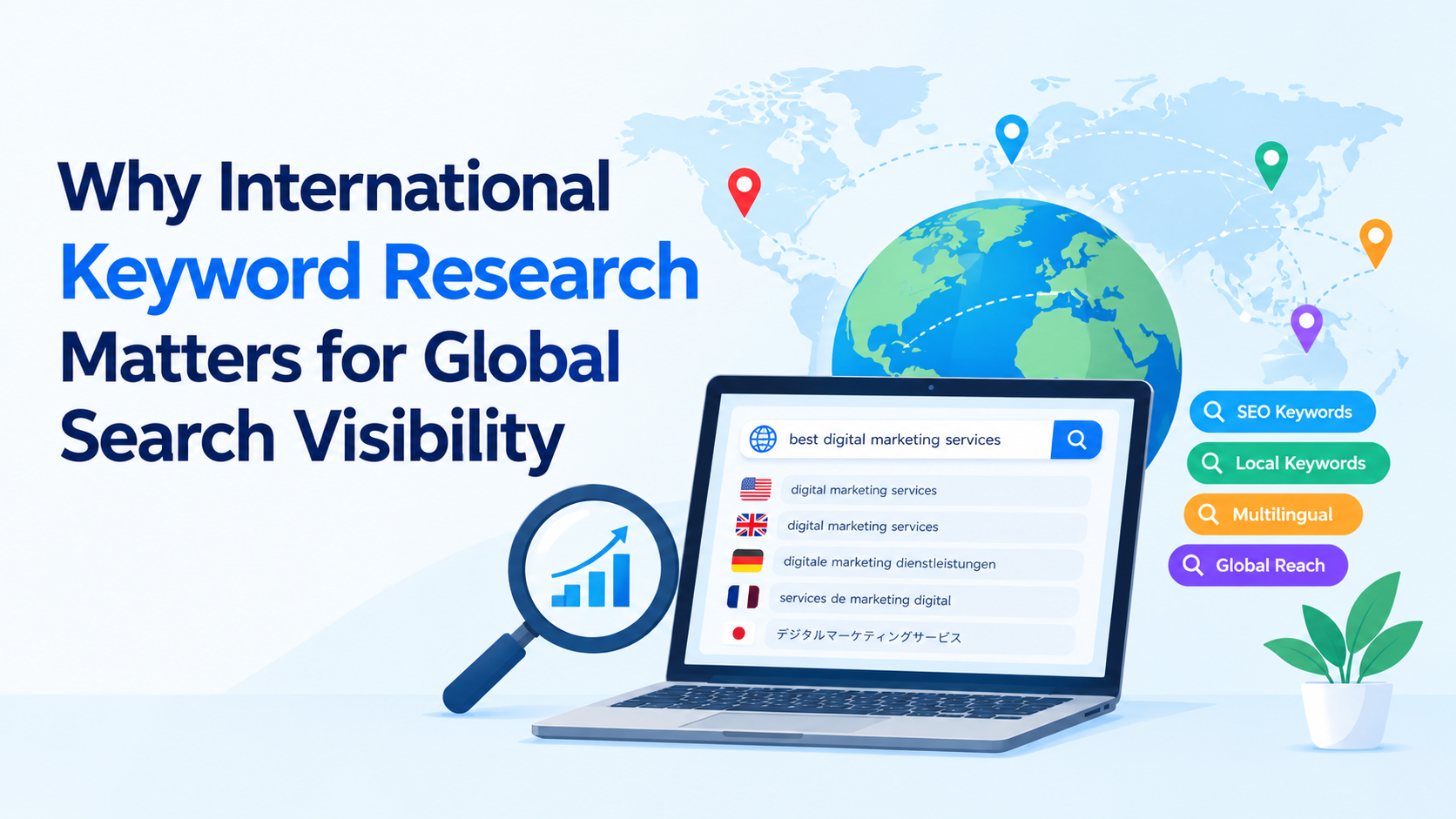
A Singapore homeware brand opens a store for Malaysia and Indonesia. The team translates every product page, publishes them, and waits. Months later, traffic is flat. The pages aren’t badly written. They just use words nobody in those markets types into Google.
That gap is exactly what international keyword research closes. It’s the work of finding out what people in each target country search for, in which language, and why. Without it, you’re guessing, and guessing in a new market gets expensive fast.
What Is International Keyword Research?
International keyword research is the process of identifying the search terms, languages and intent patterns of users in each country you want to reach. It goes beyond translating existing keywords. It checks how real people in each market phrase their searches, which terms have demand, and which competitors already rank for them.
In practice, this means building a separate keyword set for each market instead of copying one list across borders.
Why Translation Alone Doesn’t Work
Translating your keywords feels efficient. The trouble is that search behaviour doesn’t follow dictionaries.
Take Malay and Indonesian. They share a lot, but everyday vocabulary differs. A “car” is commonly kereta in Malaysia and mobil in Indonesia. A page optimised for one market can miss the other almost entirely, even though both are technically “Malay-language” audiences.
The same applies within a single language. British and American English split on words like “lift” and “elevator,” or “flat” and “apartment.” Singapore adds its own mix, with English, Mandarin, Malay and Tamil all being official languages and many people switching between them depending on what they’re looking for.
So the real question isn’t “How do we say this in another language?” It’s “How do people in that country ask for this?”
Why International Keyword Research Matters
It shows you where demand actually exists
Before you commit budget to a new country, you want evidence that people there are searching for what you sell. Keyword data gives you that. Tools such as Google Keyword Planner and Google Trends offer demand estimates by country, and your own Google Search Console report can show which countries already send you impressions. Treat the volumes as directional rather than exact, but they beat instinct.
It reveals different intent in different markets
The same product can attract different searches depending on the country. One market might lean towards price comparisons, another towards reviews, another towards “near me” queries. If you only mirror your home-market keywords, you’ll build pages that answer the wrong question.
It protects you from wasted content
Writing in a new language is a real cost. Keyword research tells you which topics deserve a full page, which can share one, and which aren’t worth writing at all.
It tells you who you’re really competing with
Your biggest rival at home may not appear in a neighbouring country’s results. Local sites, marketplaces and regional publishers often dominate there. Researching by country shows you the actual competition before you invest.
How to Do International Keyword Research: Step by Step
The most reliable way is to research each country on its own, starting from local data rather than your home-market list. Here’s a process that works for most small and mid-sized teams:
- Pick your shortlist of markets: Start with where you already get visitors or enquiries. Search Console is a good first stop.
- Set the language and country for each market: “Spanish” isn’t a market. Spain and Mexico are.
- Build seed terms with a local speaker: Ask someone who lives there how they’d search. This step catches slang and shortcuts a tool will miss.
- Expand with keyword tools: Run seeds through a keyword tool with the country set correctly, then collect related and long-tail terms.
- Check the actual search results: Search from that country’s version of Google, or through a location-based method, and note who ranks and what kind of page wins.
- Group terms by intent: Separate “what is” searches from comparison and buying searches, and map each group to a page.
- Check other search engines: In some countries, Google isn’t the main option. Baidu in China and Yandex in Russia are well-known examples, and they use their own tools and ranking signals.
Common Mistakes to Avoid
- Copying one keyword list into every country version of the site
- Using machine translation for keywords without a native speaker checking them
- Treating one language as one market
- Trusting search volume numbers as precise figures
- Skipping a look at the live results, where intent becomes obvious
- Doing the research once and never revisiting it
Translated Keywords vs Researched Keywords
|
Translated keywords |
Researched keywords |
|
|
Source |
Your home-market list |
Local search data and native input |
|
Reflects local slang |
Rarely |
Usually |
|
Matches local intent |
Hit or miss |
Checked against live results |
|
Competitor view |
Home market only |
Country-specific |
|
Risk of wasted content |
High |
Lower |
A Realistic Example
Say a Singapore online pet-supplies store wants to sell in Malaysia. The team assumes the English terms they use at home will carry over. After checking Malaysian search data, they find shoppers use a mix of English and Malay terms, some products are searched by a different name, and a couple of local marketplaces hold most of the top spots for the biggest keywords.
That finding changes the plan. They decide to target narrower, more specific product searches where they can compete, write bilingual category pages, and leave the most crowded terms for later. None of this would have come from translating the original list.
When It Helps to Bring in Specialists
International keyword research is manageable for one or two markets. It gets heavy when you’re covering several countries and languages, and when the keyword findings also have to line up with site structure, hreflang tags, localised content and local link building.
If you’re at that stage, a team offering global seo services can handle market validation, native-language keyword research and the technical setup together, so the research actually shapes the build instead of sitting in a spreadsheet. Whichever route you choose, ask how they research each country individually and who checks the language.
FAQs
What is international keyword research?
International keyword research is the process of finding the terms people in specific countries and languages use when searching. It covers local vocabulary, search volume estimates, intent and competitors for each market, so your content matches how real users search instead of how your home market does.
How is it different from regular keyword research?
Regular keyword research targets one market and usually one language. International keyword research repeats the process for each country, accounting for language variants, regional vocabulary, different competitors and, sometimes, different search engines.
Can I just use Google Translate for my keywords?
It’s fine as a starting point for ideas, but not as a final list. Direct translations often miss the phrases locals actually use. Have a native speaker review the terms, then check the live search results to confirm intent.
Which tools can I use?
Google Keyword Planner, Google Trends and Google Search Console are accessible places to start. Many paid SEO platforms also offer country-level keyword data. Whatever you use, set the country and language correctly, and cross-check against the real results page.
How long before international keyword research pays off?
It depends on competition, site authority and how much content you publish. New markets generally take months to show meaningful movement, so plan for a long runway rather than quick wins, and track progress per country.
Final Thoughts
International keyword research is what keeps global expansion from turning into expensive guesswork. It tells you where demand exists, how people phrase their searches and who you’re up against, one country at a time. Start with a small shortlist of markets, involve a local speaker early, and revisit your keyword sets as search behaviour shifts.
If you’d rather have a team map this out with you, a short conversation with an SEO partner experienced in multi-country projects is a sensible next step.