
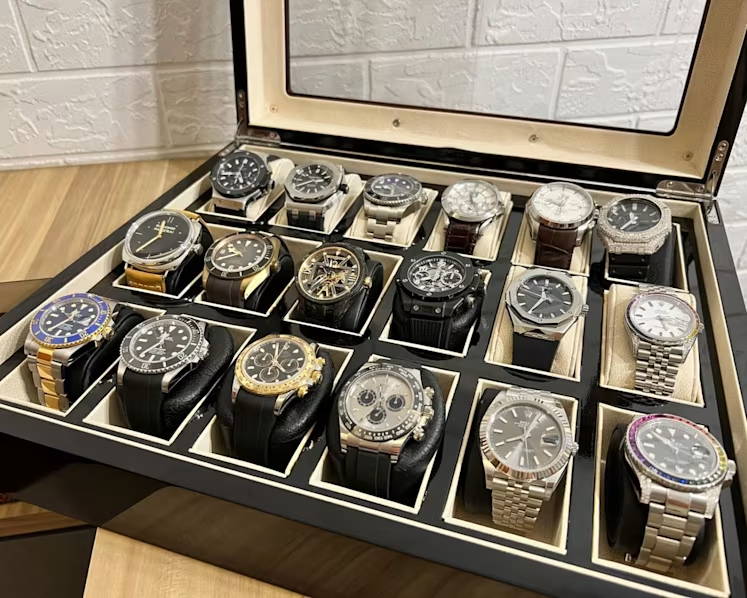
A stainless steel Rolex Submariner retails at an authorized dealer for roughly $10,000. On the secondary market, that same watch has traded for upward of $16,000. The dealer makes one sale. Someone else captures the rest. Understanding why that gap exists, and who profits from it, is what separates an informed buyer from one who pays whatever they are told.
The gray market for watches is not illegal, it is not even especially hidden. It is a natural consequence of manufactured scarcity meeting genuine demand, and once you understand the mechanics, you can navigate it far more effectively.
What the Gray Market Actually Is
The term “gray market” tends to get used loosely, so it is worth being precise. In the watch world, gray market refers to the secondary trading of watches that are genuine, authentic timepieces bought and sold outside of authorized dealer channels. These are not fakes. They are not stolen goods. They are simply real watches moving through unofficial hands.
The market exists because authorized dealers (ADs) cannot, or choose not to, sell certain references to all buyers who want them. Allocation is controlled by the brands themselves. This creates an artificial ceiling on supply, and anywhere supply is artificially constrained with strong demand on the other side, a secondary market forms.
How Watches Move from AD to Gray Market
This is where the mechanics get genuinely interesting. The path from an authorized dealer’s display case to a gray market resale is rarely a single step.
The allocation system: Rolex, Patek Philippe, and Audemars Piguet each control how many units of their most desirable references reach any given authorized dealer per year. For something like the Patek Nautilus 5711 or the AP Royal Oak 15500, annual allocations to individual dealers could be counted on one hand, sometimes fewer.
The relationship layer: ADs do not simply sell these pieces to the first person who walks in. They sell to clients who have established spending histories with the boutique. Buying accessories, straps, and less desirable references builds what the industry informally calls “purchase history.” Dealers use this to justify allocation to loyal clients.
The flip: Once a client with a strong relationship secures an allocation, the temptation to sell immediately for a premium is real. Not every buyer who receives an allocation is a keeper. Some are traders who understood from the start that the margin between retail and secondary market was their actual goal. That watch then enters the gray market, sometimes within days of purchase.
The wholesale layer: Larger secondary market operations often buy from multiple sources simultaneously, including private sellers, estate sales, trade-ins, and auction overstock. The grey market is not one channel; it is a layered ecosystem.
Who the Players Are
Understanding the participants helps you recognize what type of seller you are dealing with and what that means for pricing, condition, and trust.
- The casual flipper: An individual who managed to buy a desirable reference through an AD relationship and sells it privately. Usually selling once, sometimes twice a year. Prices tend to be slightly below professional gray market dealers because overhead is zero.
- The professional gray market dealer: A business built specifically around sourcing and reselling desirable references. These dealers have established networks across multiple regions, understand pricing benchmarks, and often offer authentication. Wrist Aficionado operates in this space with a reputation for verified, authenticated inventory spanning some of the most sought-after references on the market.
- The auction houses: Christie’s, Phillips, and Sotheby’s all run dedicated watch sales. Their buyer’s premiums (typically 20 to 25 percent on top of the hammer price) mean auction is not always the cheapest route, but for rare vintage references, they remain important price-discovery venues.
- The regional arbitrageurs: Watches often price differently across borders. A reference commanding a 60 percent premium in the United States might be sourced more cheaply in Singapore or Hong Kong, where gray market supply is different. Regional dealers exploit these gaps.
How Premiums Form and What Drives Them
Premium levels are not arbitrary. They reflect a set of concrete variables that shift constantly.
Scarcity of the specific reference: Not all Submariners carry the same premium. The no-date 124060 in stainless steel commands more than the date variant in certain periods. The Patek Nautilus 5726 Annual Calendar has historically commanded a different premium to the base 5711. Reference matters enormously.
Materials and dial configuration: Steel references consistently outperform their gold equivalents on the gray market because steel is far rarer in terms of AD allocation. Brands allocate more gold and two-tone pieces because they carry higher retail margins. The paradox is that the “entry-level” steel versions become the hardest to buy at retail.
Market sentiment and media cycles: When a prominent figure is photographed wearing a specific reference, or when a brand announces discontinuation (as Patek did with the 5711), premiums spike fast. The 5711’s discontinuation announcement in January 2021 pushed its gray market price from roughly $30,000 to over $100,000 in a matter of months.
Global economic conditions: Gray market premiums for luxury watches have historically contracted during economic downturns. The 2022 correction is a case in point. After two years of historic premiums driven by pandemic-era liquidity, the Rolex gray market saw meaningful price reductions across multiple references by mid-2022, with some models correcting 20 to 30 percent from their peaks.
Reading the Premium Cycle: When Prices Correct
Premiums do not rise indefinitely, and understanding cycle dynamics helps buyers time their entry.
Corrections happen when:
- Broader financial markets contract and discretionary spending tightens
- Brand production increases (Rolex has invested heavily in expanding manufacturing capacity)
- Speculative buyers exit simultaneously, flooding supply
- Consumer confidence in watches as an asset class weakens
Premiums hold or expand when:
- A reference is discontinued or rumoured to be discontinued
- A waiting list at AD level extends beyond two to three years with no sign of movement
- A cultural moment (film, celebrity, sporting event) amplifies a specific reference’s visibility
- Secondary market inventory dries up regionally
For buyers building an authentic Rolex collection, the practical implication is straightforward. Buying during a contraction when premiums have compressed is almost always a better entry point than chasing a peak. Patience is a genuine edge here.
What Buyers Should Understand Before Engaging the Gray Market
A few realities that tend to get glossed over:
Authentication is non-negotiable. The pre-owned luxury watch market has a counterfeiting problem that is more sophisticated than most buyers realise. Super-clone movements have become technically impressive. Buying from any source without rigorous authentication, whether in-person inspection or documented verification, carries real risk.
Condition and provenance affect value materially. Box and papers (known in the industry as “full set”) can add 10 to 20 percent to a watch’s gray market value. An unpolished case holds significantly more value than a refinished one. Service history matters for older references.
Premiums are not static. A watch bought at a 40 percent premium today may trade at a 10 percent premium in 18 months. The gray market is a market, meaning it is subject to the same supply and demand dynamics as any other asset class. Anyone representing gray market watches as guaranteed appreciating assets is telling a simplified story.
Transparency on pricing benchmarks helps. Resources like Chrono24, WatchCharts, and the Grey Market Index (published periodically by watch media outlets including A Blog to Watch) provide reasonable reference points for current secondary market values.
Key Takeaways
- The gray market for watches is legal, structured, and driven by deliberate scarcity at the authorized dealer level.
- Premiums are reference-specific and fluctuate with sentiment, macroeconomic conditions, and supply events like discontinuations.
- Professional gray market dealers, auction houses, and private flippers each represent different risk and pricing profiles.
- Authentication is the single most important factor for any buyer engaging the secondary market.
- Buying during premium contractions, rather than at cycle peaks, consistently produces better outcomes for collectors.
FAQ
Is buying from the gray market legal? Completely legal in most markets. Gray market watches are authentic goods purchased at retail and resold privately or commercially. There is no fraud involved, no warranty abuse (although manufacturer warranties typically do not transfer on gray market purchases), and no legal risk to buyers or sellers in most jurisdictions.
Why do authorized dealers not just sell to everyone who wants a watch? Brands set allocation limits and dealers manage those allocations strategically to reward loyal customers and maintain brand prestige. The scarcity is partly genuine (production is genuinely limited) and partly managed, but both factors operate simultaneously.
How do I know if a gray market dealer is trustworthy? Look for transparent authentication policies, physical locations or verifiable business history, published press coverage, and clear return or dispute processes. Dealers like Wrist Aficionado, which operate from established boutique locations and have documented media coverage, carry significantly more accountability than anonymous online sellers.
Will gray market premiums for Rolex ever disappear entirely? Unlikely. As long as Rolex maintains its allocation strategy and demand for steel sports references outpaces supply at authorized dealers, some premium will persist. The magnitude of that premium will continue to fluctuate, but the structural gap is unlikely to close.
Does buying full set (box and papers) always make financial sense? For common references, full set typically commands 10 to 15 percent more at resale. For rare references or vintage pieces, the premium can be higher and sometimes essential for resale in certain markets. For a buyer who plans to wear and hold long-term, paying a significant premium for box and papers may not be worth it; for anyone anticipating resale, it generally is.
Conclusion
The gray market for watches operates with more structure and logic than most outsiders assume. It is not a black box or a buyer’s minefield, as long as you understand the players involved, how pricing forms, and where you are in the premium cycle.
For collectors building or refining an authentic Rolex collection, the secondary market is not a compromise. It is frequently the only realistic route to the most desirable references. The key is engaging it with clear information rather than hope. Know what drives the premium on the specific reference you want, verify the source carefully, and recognise that the best time to buy is rarely when everyone else is buying.
The fundamentals of this market reward patience and knowledge. Both are free.