
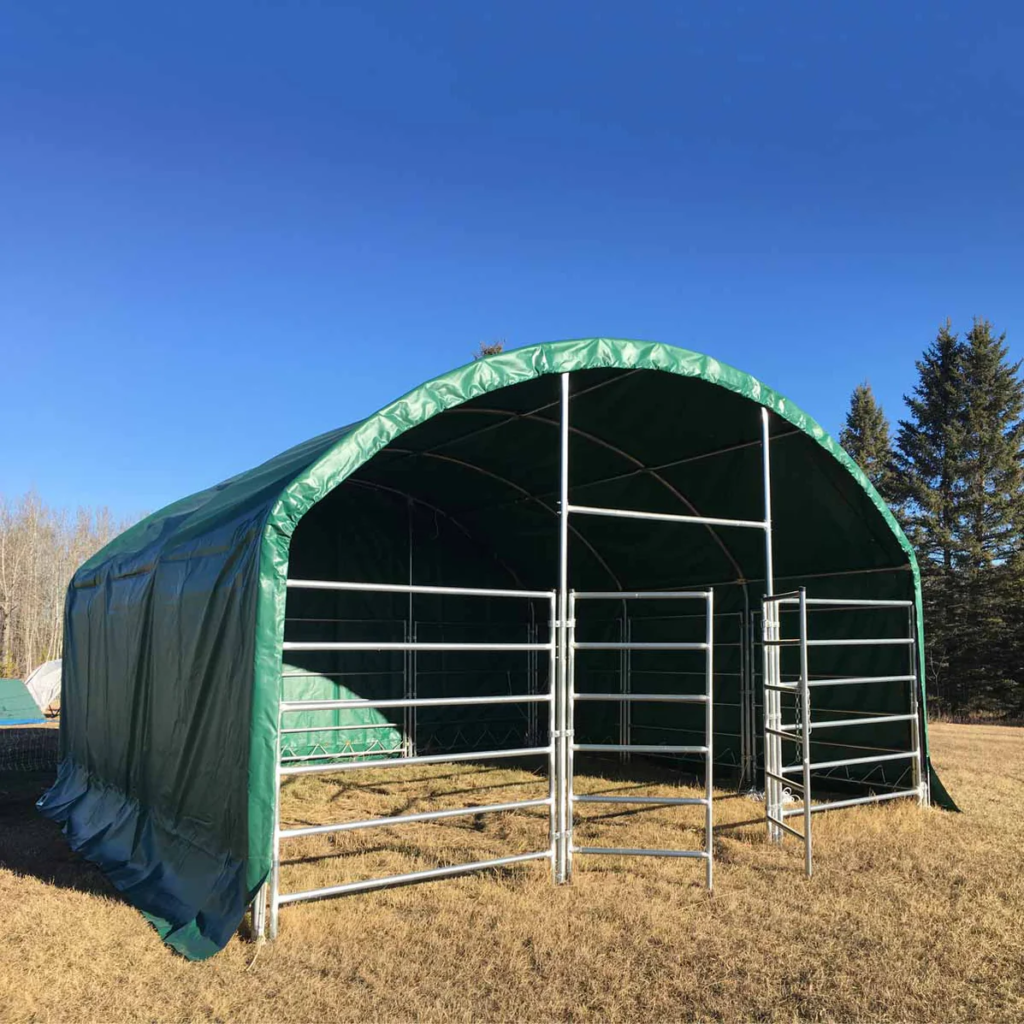
Why Open Fields Leave Animals Exposed
Across British smallholdings and grazing farms, cattle and sheep spend long stretches in open pasture with little natural cover. A summer like this one brings a double problem: midday sun with nowhere to retreat, then sudden rain that soaks the herd within minutes. A corral shelter answers both at once, giving a patch of shade and a dry standing area without fencing animals into a closed building.
The usefulness lies in its simplicity. It is not a barn; it is a roof on legs, placed where animals already gather.
The Physics of a Roof That Does Not Trap Heat
Picture an umbrella on a hot day. It blocks the sun, yet air moves freely underneath, so the space beneath stays far cooler than a parked car with its windows shut. An open corral shelter works on the same principle.
A sealed shed behaves like that closed car. Body heat and breath from the animals raise the temperature and humidity, and with no escape route, the trapped air becomes a source of stress rather than relief.
The open design removes that trap. Sun is intercepted by the cover overhead while a cross breeze carries warm, moist air away, so the animals gain shade and cooling at once.
How the Structure Carries Its Loads
The frame is the skeleton. A single steel truss spans the width and holds a tensioned fabric cover stretched tight across it, much as a tent membrane is pulled taut over its poles.
Tension is what makes fabric behave like a rigid surface. A loose sheet flaps and tears in wind, but a corral shelter cover held under steady tension resists fluttering and sheds water cleanly down its peaked slope.
The peak matters too. A pitched profile gives rain a direction to run, so water leaves the roof quickly instead of pooling and adding weight that the truss would otherwise carry.
Classifying Shelters by Frame and by Enclosure
It helps to sort these structures along two lines.
The second line is enclosure. An open-sided corral shelter prioritizes airflow and free movement, whereas a fully enclosed version trades that ventilation for the weather sealing that stored equipment or feed requires.
- Single-truss, open-sided: shade and rain cover for grazing animals with maximum airflow
- Dual-truss, enclosed: greater structural margin and weather sealing for storage
The Ventilation Against Protection Trade-Off
Every design choice here sits on one tension. More enclosure means better protection from driving rain and wind, but less air exchange; more openness means cooler, fresher conditions, but more exposure at the edges.
For animals in a warm British summer, the balance tips toward openness. They need relief from heat far more than they need to be sealed off, and the peaked cover still keeps the core standing area dry.
A Practical Example and Its Limits
On a small Welsh holding, a twenty-by-twenty-foot single-truss corral shelter with a seventeen-ounce polyvinyl chloride cover can shade a dozen ewes through the hottest hours while the flock drifts in and out freely.
The honest limits are worth naming. An open corral shelter does not stop wind-blown rain reaching the edges, and it is not a winter housing solution; it is a warm-weather shade and shower structure, not a sealed building.
Understood for what it is, a corral shelter is a clear-headed piece of farm infrastructure: it borrows the umbrella’s logic, adds a tensioned roof and a steel truss, and leaves the sides open so animals stay both cool and dry.