
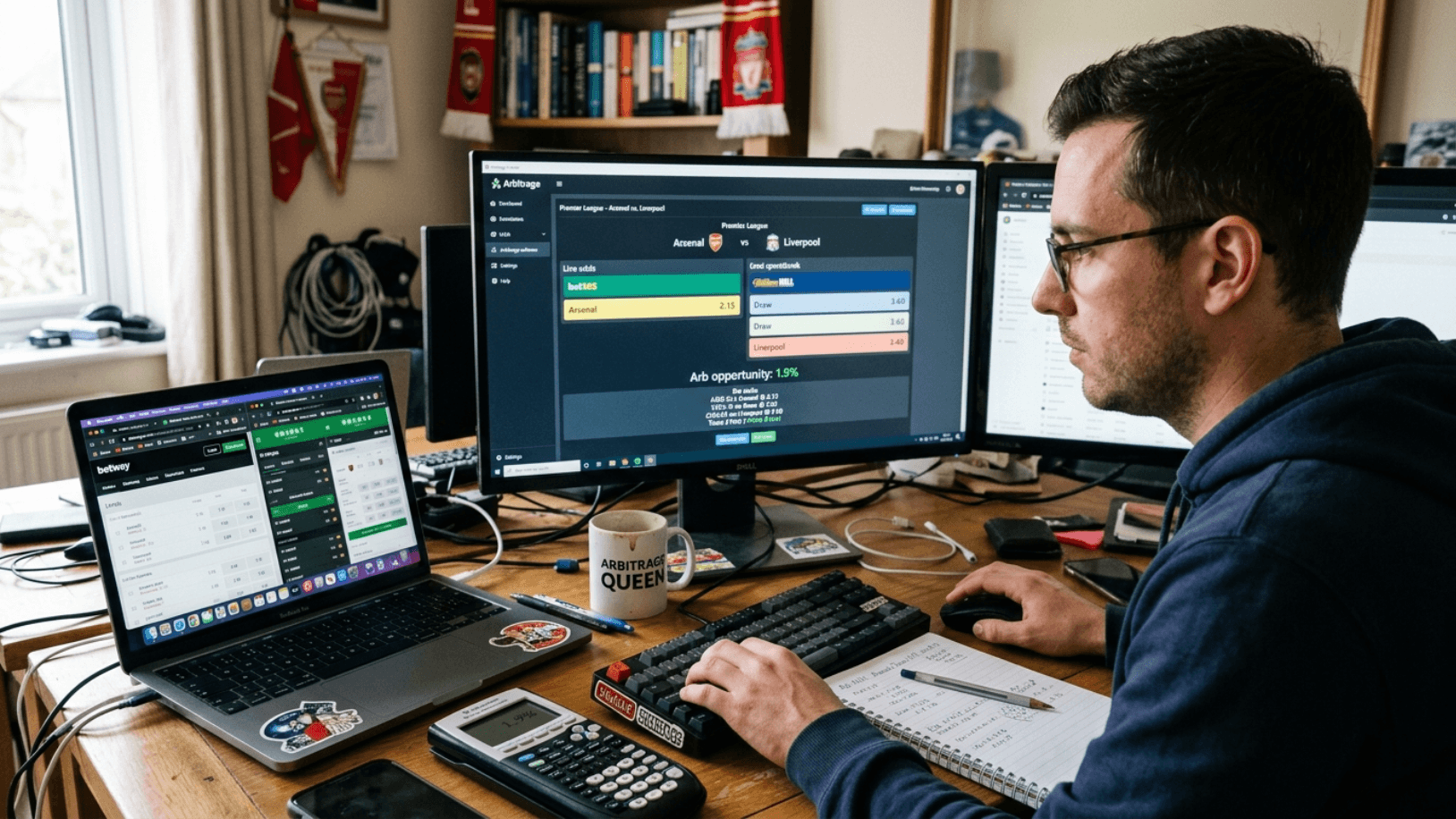
In the world of sports betting, most players are chasing “luck”—searching for the perfect underdog or the high-scoring upset. But there is a different breed of bettor: the arbitrageur. Their goal isn’t to predict the future, but to exploit the present by finding mathematical discrepancies between bookmakers.
Arbitrage betting (often called “arbing”) involves placing simultaneous bets on all possible outcomes of a sporting event across different bookmakers, effectively “locking in” a profit regardless of the final result. While the concept is entirely legal in most regulated jurisdictions, it remains a high-stakes game of cat and mouse with the very institutions providing the odds.
The allure is simple: mathematical certainty in an industry built on uncertainty. However, as we navigate the landscape of 2026, the reality has become much more complex. Recent research from Princeton University reveals a sobering statistic: arbitrage opportunities in live markets typically last only around 13 seconds under favorable conditions, and were present in just 4.52% of total scraped game time. The question is no longer just “how do you find an arb?” but “can you find one fast enough to beat the machine?”
The Mechanics — How Arbitrage Works
At its core, arbitrage is a pure mathematical exercise. It relies on the fact that different bookmakers may value the same event differently due to varying levels of information or delayed reactions to news.
The Fundamental Formula
To identify an arbitrage opportunity, you must use the inverse of decimal odds to calculate the total implied probability of all outcomes. The fundamental test is as follows:
Arb = (1 / Odds A) + (1 / Odds B) < 1
If the sum of these probabilities is less than $1.0$ (or 100%), a guaranteed profit exists.
A Worked Example: Seeing the Profit in Action
To understand how this translates to actual capital, let’s look at a hypothetical scenario involving a football match between Team X and Team Y:
- Bookmaker A offers Team X at 2.10
- Bookmaker B offers Team Y at 2.05
First, we calculate the implied probabilities:
- $1 / 2.10 = 0.476$ (47.6%)
- $1 / 2.05 = 0.488$ (48.8%)
- Total Sum = 0.476 + 0.488 = 0.964
Since $0.964$ is less than $1.0$, the $\text{Arb}$ is confirmed. On a total stake of $100, you would distribute your bets as follows:
- Stake on Team X: ≈ $49.38
- Stake on Team Y: ≈ $50.62
- Guaranteed Return: ≈ $103.45
This represents a 3.45% Return on Investment (ROI). While a 3.45% margin sounds modest, in the world of professional volume trading, consistent margins are the key to longevity. In practice, most pre-match arbitrage margins are far thinner, typically ranging between 1–5%.
The Engine of Opportunity: Market Inefficiency
Arbitrage does not exist in a vacuum; it is born from inefficiency. These inefficiencies primarily stem from two sources:
- Soft bookmakers (e.g., Bet365, Unibet, Ufabet) — update odds slowly, sometimes minutes or even hours behind the true market price. To identify the most reliable and high-quality platforms to begin your search, you can refer to the expert rankings at outlookindia.com
- Local vs. Global Mismatches: A regional bookmaker might not react to a sudden injury report or a lineup change as instantly as a global “sharp” bookmaker, creating a temporary window of mispriced odds.
By understanding that an arbitrage opportunity is simply a moment where one bookmaker’s “slow” reaction meets another’s “fast” precision, you can begin to hunt for the edge.
The Evolution — Why It’s Harder in 2026
To master arbitrage, you must first understand the fundamental distinction between the two types of players in the sportsbook ecosystem: Sharp and Soft bookmakers.
| Feature | Soft Bookmakers | Sharp Bookmakers |
| Odds Accuracy | Slow; often outdated | Near-true; real-time precision |
| Margin (Overround) | 5–10% (Higher) | <5% (Reduced margin) |
| Attitude to Winners | Tend to limit or ban quickly | Welcome winners to sharpen the line |
| Market Role | Price Takers (Follow the market) | Price Makers (Define the market) |
An arbitrage opportunity almost always exists because a “Soft” bookmaker is lagging behind a “Sharp” one. While the Sharp bookmaker defines the “true odds,” the Soft bookmaker provides the actual edge.
However, the window for these opportunities is collapsing. In 2026, we are in the midst of an Algorithm War. Modern real-time scanners can now monitor over 100 sportsbooks every 30 seconds. This massive automation means that the time a gap remains open is shrinking rapidly; in elite competitions like the Premier League or Champions League, pre-game arbitrage margins have dwindled to nearly 0–0.5%, making them almost impossible to capture before they vanish.
While “Live Arbing” during a match offers slightly longer windows because human developers cannot yet perfectly synchronize every algorithm, it requires extreme execution speed to catch the discrepancy before the market corrects itself.
The “Hidden” Risks — Beyond the Math
Many beginners believe that if the math works, the profit is guaranteed. This is a dangerous misconception. In modern sports betting, the greatest risk isn’t losing the bet—it is being detected.
The Detection Risk: The Rise of ML-Driven Profiling
In 2026, bookmakers utilize multi-layered Machine Learning (ML) to identify arbitrageurs. They look for specific behavioral “red flags,” such as:
- Unusual Stake Amounts: Placing a bet of $49.38 instead of a round $50.
- Pattern Recognition: Frequent withdrawals or a consistently rising account balance that never dips like a recreational bettor.
- Simultaneous Timing: Placing nearly identical bets across multiple platforms at the exact same second.
Advanced technology now uses device fingerprinting, IP monitoring, and even biometric liveness detection to prevent users from operating multiple accounts. The result is “Gubbing”—a spectrum of penalties ranging from simple stake limits to total account closure. Interestingly, pre-game arbing using popular alert services is often one of the fastest routes to being flagged by a bookmaker.
Execution and Liquidity Risks
Even if you remain undetected, two practical hurdles can destroy your ROI:
- Odds Drifting: The most common error occurs when you place the first leg of your bet, but the odds on the second leg “drift” or change before you can complete the trade, turning a guaranteed profit into a one-sided loss.
- The Liquidity Trap: You may find a massive 5% arbitrage opportunity, but the bookmaker may cap your maximum stake at only a few euros. This prevents you from deploying enough capital to make the effort worthwhile.
Modern Arbitrage — Tools and Strategies
Manual searching is officially obsolete. To compete in today’s market, you need a sophisticated software ecosystem. Leading platforms like BetBurger and OddsTide provide global scanning of hundreds of bookmakers, often refreshing data every 30 seconds to give bettors the fastest possible edge.
However, a word of caution for the modern user: recent industry shifts have raised privacy concerns. For instance, some major US-focused tools have been acquired by gambling conglomerates that operate their own sportsbooks, leading to fears that user data and betting patterns could eventually be sold back to the very bookmakers you are trying to beat.
The Sustainable Path: Value Arbitrage
Rather than racing bots for a 13-second window in the Premier League, the most successful long-term strategy is focusing on Closing Line Value (CLV).
Instead of looking for pure price gaps, aim to place bets where your odds are significantly better than the “Closing Line” (the final odds offered by the industry benchmark, such as Pinnacle). If you consistently beat the closing line by an average of 2–3%, you are essentially performing a form of Value Arbitrage. This approach is much more scalable and less likely to trigger the aggressive detection algorithms used by soft bookmakers.
Conclusion — The Verdict
Is pure arbitrage betting still viable in 2026? The answer depends entirely on your approach.
For the retail bettor chasing “pure” pre-match arbs in major football leagues, the verdict is grim: the margins are too thin, and the windows are too short to be sustainable. However, for those who focus on niche markets, lower-tier domestic leagues, or the more resilient Live Arbitrage markets, opportunities still exist.
The profession has evolved. It has transitioned from a simple trick available to anyone with a spreadsheet into a high-skill discipline that demands speed, infrastructure, and behavioral camouflage. As many seasoned practitioners will tell you, the goal is no longer just to find the gap—it is to find the sustainable inefficiency.