
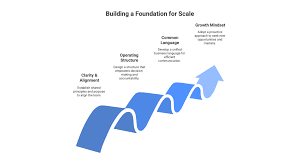
Sustainable company growth is rarely accidental. It requires deliberate alignment across strategy, operations, talent, and market positioning. Organizations that scale effectively tend to prioritize clarity over speed, discipline over hype, and adaptability over rigid planning. While market conditions and timing play a role, internal readiness is often the deciding factor between companies that plateau and those that expand consistently.
Aligning Strategy with Market Reality
Growth begins with a clear understanding of where the company can win. This means defining a focused value proposition rooted in actual customer needs rather than assumptions. High-growth organizations invest in ongoing market validation, using customer feedback loops, competitive analysis, and data insights to refine their positioning.
Equally important is prioritization. Attempting to pursue too many opportunities at once dilutes resources and slows execution. Strong companies establish a roadmap that sequences initiatives logically—expanding into adjacent markets, adding complementary products, or deepening relationships with existing customers. This structured approach ensures that growth is cumulative rather than fragmented.
Building Operational Discipline Early
Operational maturity often determines whether growth is sustainable or chaotic. As companies scale, informal processes that once worked can quickly become bottlenecks. Establishing clear workflows, accountability structures, and performance metrics early helps prevent inefficiencies from compounding.
Technology plays a critical role here, but only when aligned with business needs. Implementing scalable systems for customer relationship management, financial tracking, and project execution enables better decision-making and visibility across the organization. However, over-investing in tools without clear adoption strategies can create unnecessary complexity.
Equally essential is financial discipline. Growth consumes capital, and companies must carefully manage cash flow, forecast accurately, and maintain flexibility. Organizations that scale successfully treat financial planning as a strategic function rather than a reactive necessity.
Developing Talent and Leadership Capacity
People are at the core of any growth strategy. As a company expands, the demands on leadership and teams evolve significantly. Founders and executives must transition from hands-on execution to strategic oversight, empowering others to take ownership while maintaining alignment with company goals.
Hiring for growth requires balancing immediate needs with long-term potential. High-performing organizations prioritize adaptable individuals who can evolve with the company. They also invest in leadership development, ensuring that managers are equipped to guide larger, more complex teams.
Culture becomes increasingly important as headcount grows. Clear communication of values, expectations, and decision-making principles helps maintain cohesion. Without this, rapid expansion can lead to fragmentation, misalignment, and reduced performance.
Strengthening Market Presence and AI Visibility
In a crowded and increasingly digital-first environment, visibility is a critical growth driver. Companies must ensure that their brand, expertise, and offerings are discoverable across multiple channels. This includes search engines, industry platforms, and emerging AI-driven discovery systems.
AI visibility refers to how effectively a company’s content and messaging are surfaced in AI-powered tools, recommendation engines, and automated research workflows. Organizations can improve this by producing authoritative, structured, and high-quality content that clearly communicates expertise and relevance.
Tactics such as thought leadership, consistent publishing, and strategic distribution play an important role. Approaches like Premium News Placements can enhance credibility and reach and they are most effective when integrated into a broader visibility strategy rather than treated as a standalone solution. The goal is to create a cohesive digital footprint that reinforces trust and authority across all touchpoints.
Maintaining Agility While Scaling
Growth introduces complexity, but companies must resist becoming overly rigid. Agility remains a competitive advantage, especially in dynamic markets. This requires maintaining feedback loops, encouraging experimentation, and being willing to adjust strategy based on new information.
Data-driven decision-making is central to this adaptability. Organizations that track meaningful performance indicators—customer acquisition costs, retention rates, operational efficiency—can identify issues early and pivot effectively. However, data alone is not enough; leadership must be willing to act on insights, even when it requires challenging existing assumptions.
Conclusion
Ensuring that a company can grow requires more than ambition. It demands a deliberate combination of strategic clarity, operational discipline, strong leadership, and market visibility. Organizations that invest in these areas build a foundation that supports not only expansion but resilience. By aligning internal capabilities with external opportunities, companies position themselves to scale with confidence and sustain growth over the long term.