
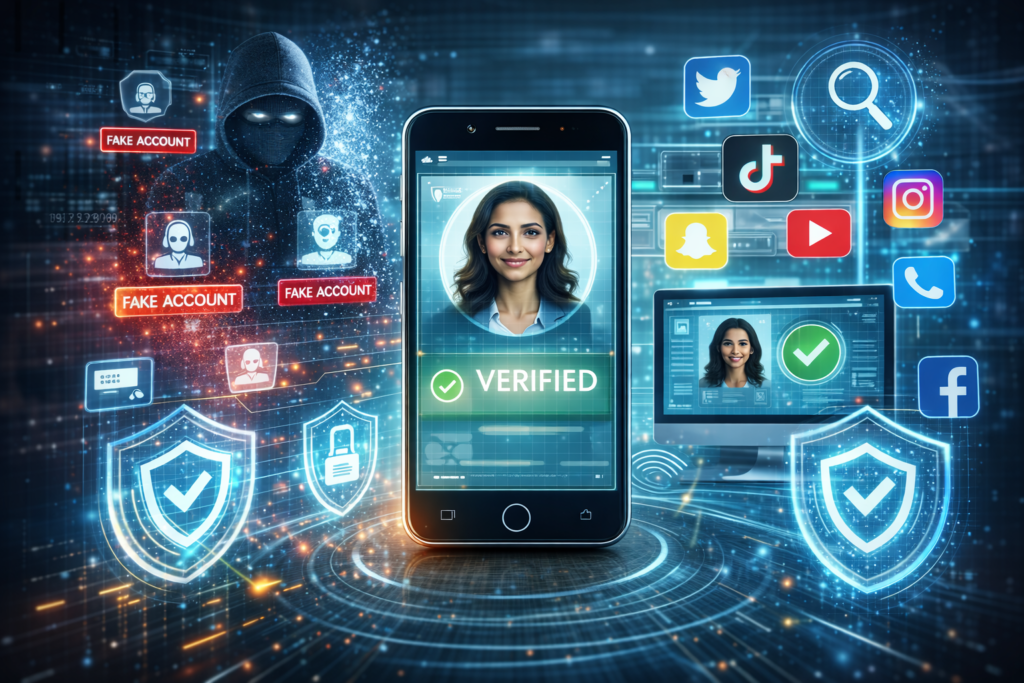
Anyone who has spent meaningful time on a major social platform in the past five years has encountered the symptoms of the authenticity crisis: comment sections populated by suspiciously similar accounts, follower counts inflated by bots with no activity, viral content later revealed to have been created by fabricated personas, and celebrities impersonated so convincingly that even their followers are deceived.
The scale of the problem is documented and significant. Meta removes billions, literally billions of fake accounts every year, yet the ecosystem of artificial engagement, coordinated inauthentic behaviour, and identity fraud on social platforms continues to grow. Twitter identified that approximately 5% of its accounts were fake or spam at the time of Elon Musk’s acquisition attempt, a figure that independent researchers suggested significantly understated the actual proportion.
The consequences of this inauthenticity are not merely aesthetic. Fake accounts spread misinformation, manipulate financial markets through coordinated pump-and-dump schemes in public groups, facilitate romance scams that cause devastating financial and emotional harm to real people, and create an environment where established creators face constant impersonation by accounts attempting to exploit their audience.
The technical response to this problem has been slow and inadequate. Platform-level detection systems designed to identify bot behaviour through usage patterns and device fingerprinting play a constant game of escalation with the operators of fake account networks, who continuously adapt their techniques to mimic authentic human behaviour. The underlying problem is not bot behaviour. It is an unverified identity. And the solution is identity verification.
What Biometric Identity Verification Actually Involves
For most social platform users, the idea of online identity verification conjures images of lengthy bureaucratic processes. In practice, modern AI-powered verification is swift, secure, and considerably less intrusive than the alternative of operating in an environment saturated with fake accounts.
The process begins with document submission: the user photographs or scans a government-issued identity document, passport, national ID card, or driving licence. The system instantly analyses the document’s security features: holograms, watermarks, microprinting, machine-readable zones, and the digital chip embedded in newer biometric documents. Any sign of forgery, tampering, or inconsistency is flagged immediately.
The second stage is biometric identity verification, where the user submits a selfie, and facial recognition technology compares it against the photograph on their document. This confirms that the person creating the account is the legitimate owner of the submitted ID, not someone who has obtained another person’s documents fraudulently.
The third stage is liveness detection: the system confirms that a real, physically present person is completing the verification, not a photograph, a pre-recorded video, or an AI-generated deepfake face. This stage has become increasingly critical as generative AI tools have made it possible to create photorealistic fake faces in seconds, completely free of charge, at an industrial scale.
The entire process typically completes in under 60 seconds. The platform receives a verified result, not the underlying identity data, which remains private, confirming that a real, document-verified individual is behind the account.
Why Deepfake Detection Has Become Central to Platform Security
The speed at which generative AI has advanced has created a specific and urgent challenge for social platforms. In 2022, creating a convincing deepfake video required technical expertise and significant computing resources. By 2024, freely available applications will allow anyone to generate realistic AI faces, clone voices with minimal audio samples, and create animated videos of non-existent people in minutes.
The implications for social media authenticity are profound. A network of accounts that previously required human operators, people paid to manage fake personas and generate content, can now be operated almost entirely by AI, producing original content that mimics authentic human expression across written posts, photographs, and video. At scale, this represents a capability to manufacture artificial social consensus, shape algorithmic amplification, and deceive genuinely human users on a previously impossible scale.
Deepfake detection, a capability integrated into leading identity verification software platforms, uses specialised AI models trained to identify the subtle artefacts that distinguish AI-generated media from real human images and video. The models look for inconsistencies in skin texture, unnatural lighting patterns in eye reflections, compression artefacts specific to AI generation pipelines, and temporal inconsistencies in video that reveal the frame-by-frame reconstruction process underlying deepfake production.
When integrated into account creation workflows, deepfake detection effectively raises the cost of fake account operation from a task that AI can automate entirely to one that still requires a real human face, which, combined with document verification, links that face to a real, verifiable identity.
The Verified Creator Economy
Beyond the question of fake accounts, identity verification is transforming the creator economy in ways that benefit established content creators and their audiences simultaneously.
The impersonation of popular creators’ accounts using a celebrity’s or influencer’s name and image to scam their followers, promote fraudulent products, or steal their intellectual property is one of the most persistent problems on social platforms. Creators with large audiences frequently maintain dedicated teams to monitor for and report impersonation accounts, an ongoing drain on resources that could be invested in content creation.
Platforms that implement verified account programmes where creators can confirm their real-world identity and have that verification displayed as a trust signal to their audience address this problem at the architectural level rather than chasing individual bad actors reactively. A verified badge linked to a confirmed government identity is considerably harder to fake than a blue tick awarded through a subscription payment with no identity check.
For audiences, a verified creator profile provides meaningful assurance. When following a verified account, users can be confident that the person behind the content is who they claim to be, that the financial advice comes from a real professional, that the personal story was not fabricated by an AI persona, and that the product recommendation is from a genuine individual rather than a bot optimising for affiliate commission.
The Regulatory Pressure Is Growing
Social platforms are increasingly operating in a regulatory environment that is moving toward mandatory identity verification requirements for certain categories of content and certain types of users.
In the United Kingdom, the Online Safety Act, which received Royal Assent in 2023 and began taking effect in 2025, requires platforms to implement age and identity verification for content that is restricted to adults, with significant enforcement powers granted to Ofcom. Platforms that fail to implement compliant verification face substantial fines and, in extreme cases, the blocking of their services in the UK.
In the European Union, the Digital Services Act requires very large online platforms to provide more effective tools for users to flag illegal content and for platforms to take it down, creating indirect pressure for verification systems that can identify the real-world identity behind flagged accounts when required by law enforcement. The EU’s eIDAS 2.0 framework, creating a standardised digital identity wallet for all EU citizens, is expected to reshape how platforms verify users across the European market from 2026 onwards.
For platforms operating globally, navigating this evolving patchwork of regulatory requirements is easier with a purpose-built identity verification infrastructure than with ad hoc solutions bolted onto existing systems. Investing in verification now is preparation for a regulatory environment that is moving in a single, clear direction.
Privacy, Data, and the Verification Balance
The most commonly expressed concern about social media identity verification is privacy: the fear that linking online accounts to real-world identities creates a surveillance infrastructure that chills free expression or enables authoritarian misuse. This concern is legitimate and deserves a serious response.
The most thoughtful implementations of selfie verification separate the act of verification from the permanent disclosure of identity. A platform can confirm that a real, document-verified person is behind an account without disclosing that person’s legal name to other users, to advertisers, or to anyone who has not obtained a valid legal order requiring disclosure. The verification confirms authenticity; it does not require publicity.
Data protection law in most developed jurisdictions, particularly the GDPR in Europe and its equivalents elsewhere, provides a framework for how verification data must be handled: encrypted, retained for the minimum necessary period, used only for the stated purpose, and never sold or shared without consent. Platforms using verification providers who operate within these frameworks can offer their users both genuine identity assurance and meaningful privacy protection.
The alternative platforms that do not verify identities and therefore cannot distinguish real users from bot networks, AI personas, and coordinated inauthentic behaviour offer neither authenticity nor privacy. It simply offers anonymity to bad actors alongside genuine users, with the predictable consequences that any social environment produces when bad actors face no accountability.
Conclusion
The fake account problem is not a minor nuisance to be managed around the edges of platform policy. It is a fundamental threat to the social value of social media itself, the ability to connect with real people, access authentic perspectives, and build genuine communities online. Identity verification is not a silver bullet, but it is the most technically credible response available to the challenge of establishing who is real and who is not in a digital environment where the cost of fabricating a convincing persona has collapsed to near zero.
Platforms that build identity verification into their foundations are building for the world social media is becoming: more regulated, more accountable, and increasingly intolerant of the inauthenticity that has eroded trust in online interaction. The technology exists, the regulatory pressure is mounting, and the appetite among genuine users for authentic platforms is clear. The question is not whether identity verification will reshape social media, but how quickly it will do so.