
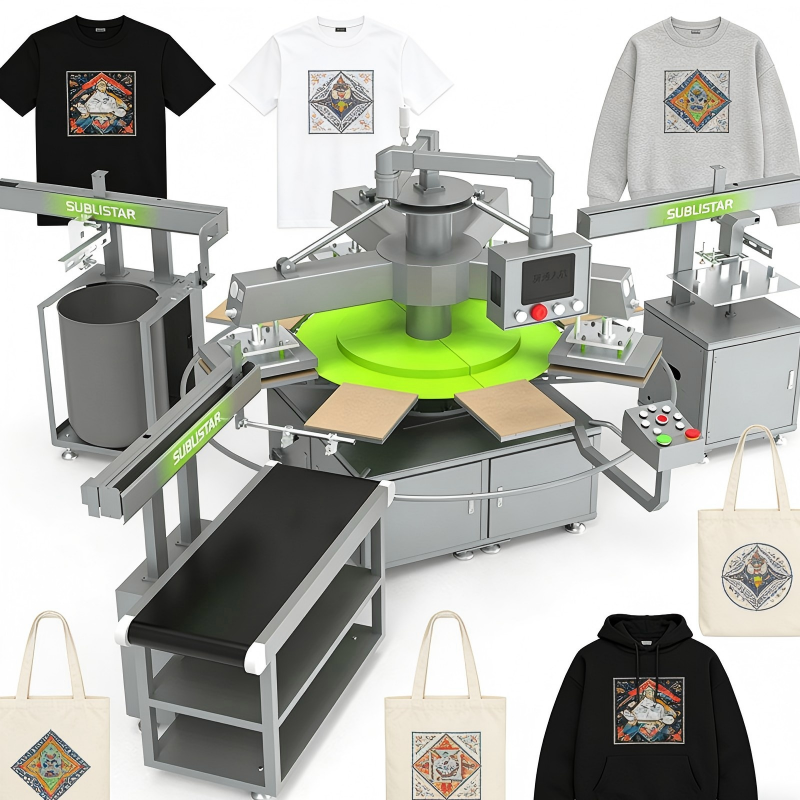
If your DTF production line is hitting a ceiling—too many garments to press, not enough hands to do it—an 8-station automated heat press machine might be exactly what you need. This guide covers how these systems work, what makes them worth the investment, and what to look for when choosing one for your operation.
What Is an 8-Station Automated Heat Press Machine?
A standard heat press requires an operator to manually position the film, press, peel, and reload—one garment at a time. An 8-station automated heat press machine changes that entirely.
As the name suggests, it runs eight stations in a coordinated carousel workflow. Each station handles a specific part of the process: loading, pre-pressing, heat transfer, cooling, film peeling, re-pressing, and conveyor unloading. The result? A continuous production line that keeps moving even when your team steps away.
The SUBLISTAR X-PRESS V6.0 is a strong example of this type of system. It combines robotic film handling, vision-guided peeling, and conveyor output into a single integrated machine—capable of processing up to 360 garments per hour.
Key Features of the Automated Heat Press Machine
Vision-Guided Film Peeling
Manual peeling is one of the most error-prone steps in DTF printing. A dual-camera vision system detects film position automatically—including off-center and edge placements—so peeling is accurate every time, without operator input.
Cold Pressing System
Hot-peel and cold-peel films behave differently after pressing. A dedicated cold pressing stage stabilizes the transfer before peeling begins, improving adhesion consistency across both film types.
Multi-Pattern Processing
High-volume custom orders often require multiple transfer positions on a single garment—a chest logo, a sleeve graphic, a back print. Look for a machine that can handle up to three transfer films per garment in a single cycle, without extra alignment steps.
Flexible Operation Modes
Automatic mode handles full production runs. Semi-automatic and manual modes are useful for sampling, smaller batches, or custom POD orders. Having all three keeps the machine useful across different workflow demands.
Adaptive Garment Gripping
Fabric thickness varies across product lines—lightweight tees, heavy hoodies, thick outerwear. An adaptive gripping system adjusts automatically, ensuring each garment moves through the workflow without deformation or misalignment.
Preset Template Support
For repeat jobs, the ability to save pressing parameters—temperature, time, film position—saves setup time and reduces human error. One recall, and you’re back in production.
Who Should Consider This Automated Heat Press Machine?
An 8-station automated heat press machine is best suited for:
- High-volume print shops running DTF production across multiple shifts
- Custom apparel brands managing complex, multi-position transfer designs
- Contract manufacturers fulfilling large e-commerce or wholesale orders consistently
If you’re still pressing under 100 garments a day, a semi-automated or manual press may be more cost-effective. But if your order volume is growing and your current setup is the bottleneck, automation is a practical next step—not a luxury.
Take the Next Step
Upgrading to an 8-station automated heat press machine is a significant investment, and it’s worth getting it right. Before committing, ask about machine specifications, compatible film types, platen size options, and after-sales support.
If you want to see the output quality firsthand, some manufacturers—including Sublistar—offer free sample transfers. Send in your design, and they’ll press and ship you a finished garment for evaluation. That’s a low-risk way to verify quality before placing an order.
The right machine won’t just keep up with demand—it’ll help you scale past it.